Journeyed up to the Sandspit River, just South of Rheban, earlier this week. I haven't visited the area in several years and I was quite surprised at the changes to the river mouth. If anyone has any doubts about global warming and the effects that is having, here might be a good place to start. The dunes on the South side have all but disappeared and much of the bank edging Earlham Farm has been undermined. While I was there an inhabitant of the small coastal village was placing rock on the shore to at least slow the erosion of his property. But you may ask, what about the birds!
 On the approach to the small coastal community, through the Earlham property, there was many Eastern Rosellas, and a few Green Rosellas, numerous Musk Lorikeets, a flock of Welcome Swallows hawking the paddocks, White-faced Herons and the usual Magpies, Miners and Butcherbirds. At the river mouth there were several Red-necked Stint (only one showing any "colour"), 4 Double-banded Plover, c.25 Red-capped Plover and a pair of Hooded Plover (pictured). I found only 3 Pied Oystercatcher, who spent most of their time playing chase, a few Pacific Gulls and a flock of around 30 Crested
  Tern (some pictured), of which at least 5 were carrying bands.
I spent sometime watching the Hoodies among the many Soldier Crabs,(see top pic) mainly because I have seen them eat them in the past. Obviously Soldier Crabs are low on their list of preferred food, as after watching for 30 minutes or so, they didn't show any interest in them at all. Presumably these crabs shed their 'skin', and go through a 'soft' shell stage, at which time they might be more appealing!
 John Tongue writes: It's interesting how we come to associate certain birds with certain locations--probably where we see them most, or have particular memories. There is a road near my home town in NSW where you can almost always see Torquise Parrots, and so I come to associate them with that place in my memory. In Tassie, I think of White Cockatoos at Epping Forest, or Claremont, or even Cornelian Bay most recently.
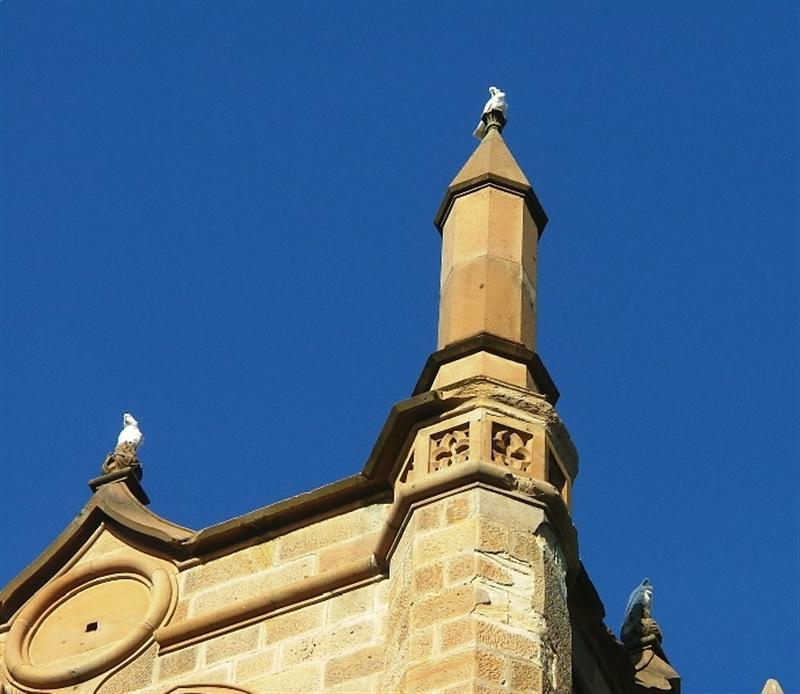
I am the rector at Holy Trinity Church (Nth Hobart), and with the church tower, I think of Ravens, or sometimes Eastern Rosellas, but the last couple of days has seen an influx of up to 55 or 60 Sulphur-crested  Cockatoos. They've been raiding nearby walnut, eucalypt, and Norfolk Pines (?) for food, and many of them perch all over the church tower, as the accompanying shots show. Unless they are just passing through looking for new food sources, we might have to come to associate them with the bell tower as much as we do Ravens!
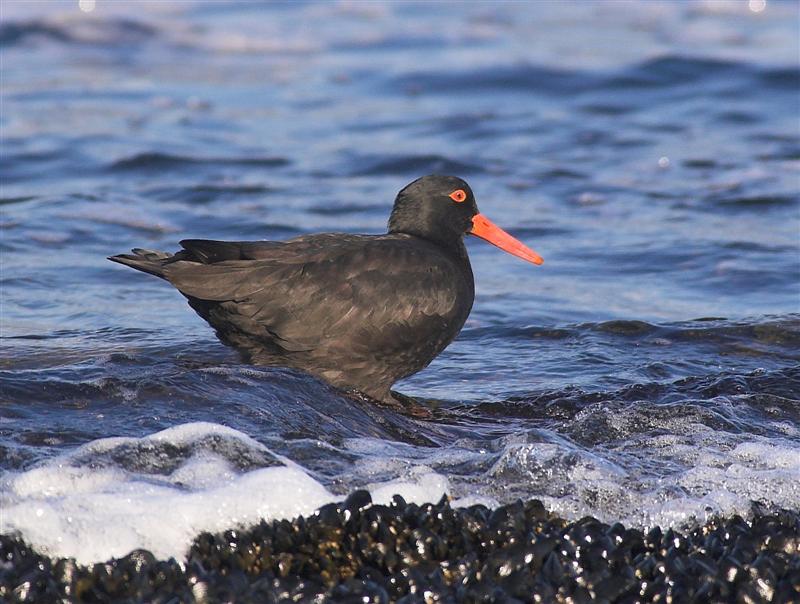
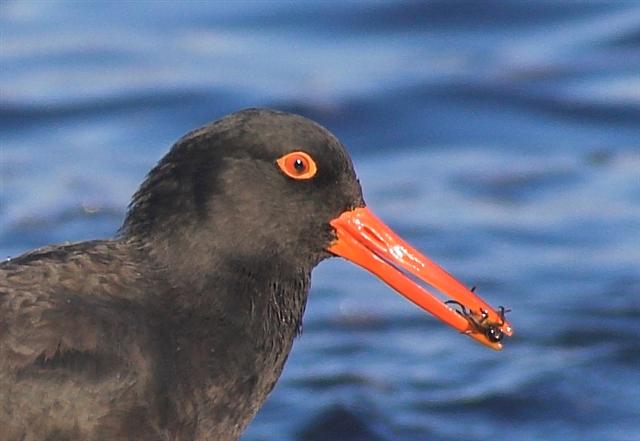
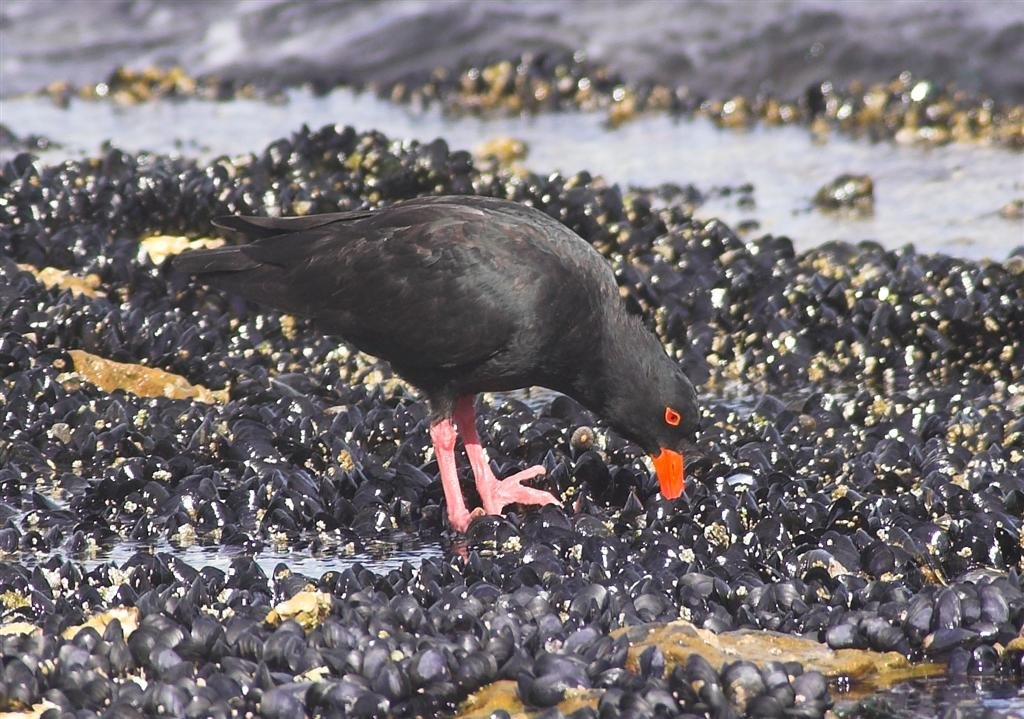
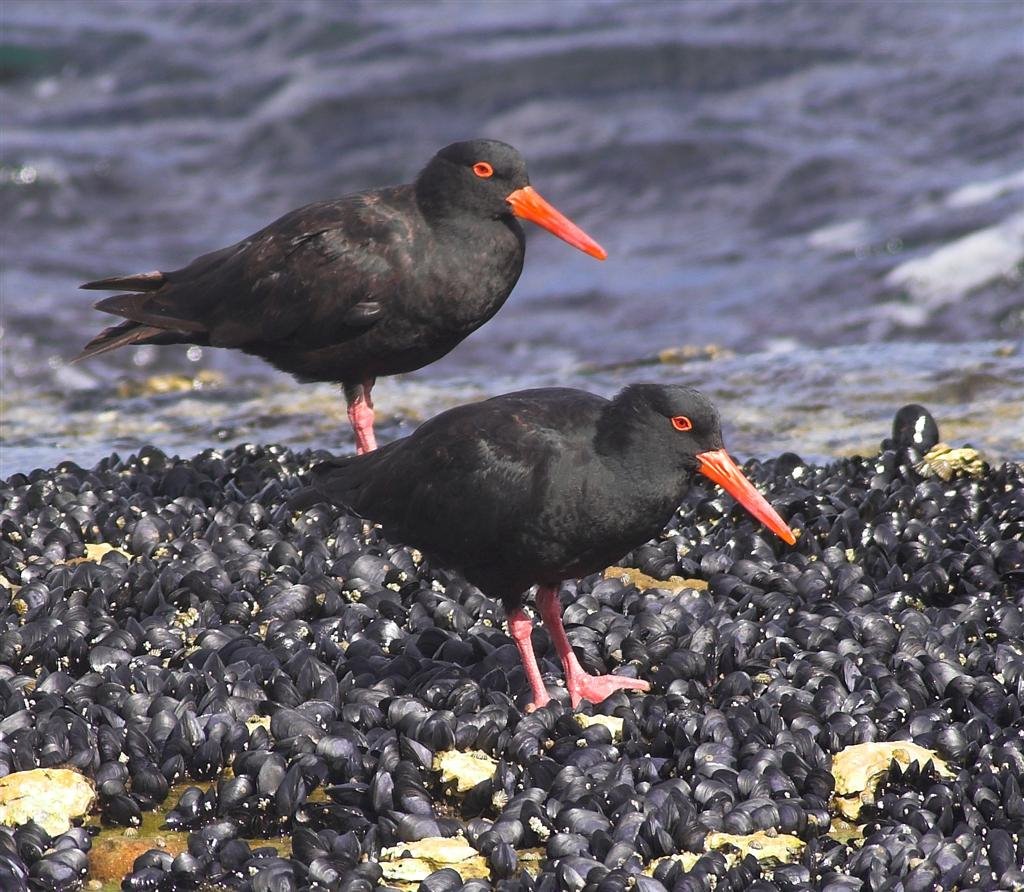
 Well perhaps partially solved! Ever since I posted a piece on mussel eating Oystercatchers, I've had a slight worry that, perhaps, that wasn't the entire truth. Certainly, at times I've seen them chisel away at the mussels, but that wasn't what my recent observations on them suggested. While photographing some Sooty Oystercatchers this morning, I 'shot' one with something in its' bill. On putting the image into the edit programme and enlarging it (see pic), I realised it was a small crab. Any fisherman using mussels for bait, would know that each mussel contains a small crab--I assume it spends its' entire life in the shell (perhaps someone could
  enlighten me)--and that would appear to be what the Oystercatchers are after,( although it is also possible there may be small crabs secreted among the mussels). There would appear to be some advantage to the Oystercatcher to feed in the wash (see pic), as at that time the mussels open, and allow a smart bird to gain access to the crab. I'm sure that's not all their feeding on-- better keep watching!
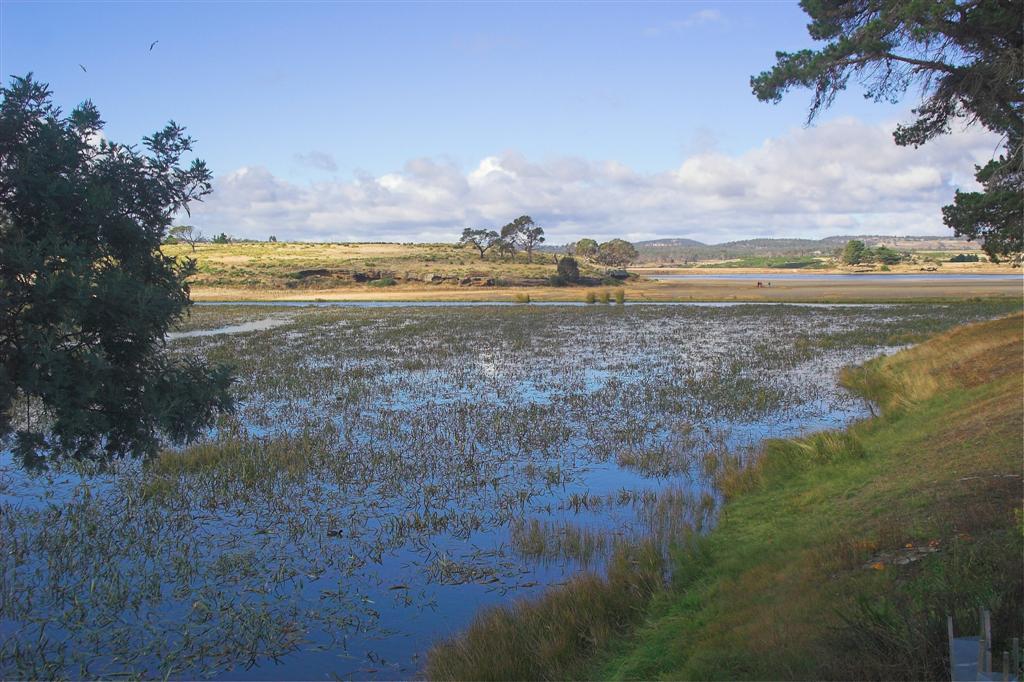
 By courtesy of my daughter, I was able to spend a short time time at Lake Dulverton on Friday morning, while she attended to some work at Ross. Having known Dulverton in its' heyday, I always go there with some sadness. While there is plenty of water in the dammed section by the road (see pic), the main area remains substantially dry. Although its' a wildfowl refuge, it's quite obvious that dogs are regularly taken out onto the 'dry' area (and vehicles), and the fact that it appears necessary to put up a notice to 'keep dogs out of the water' at the dammed section,
  begs the question of why dog owners would
think that such actions by them are appropriate.
Despite all the above, there was still a large number of ducks on the main lake, protected by the boggy areas surrounding the small area of water. Present were c.250 Chestnut Teal, c20 Grey Teal (first I've seen for sometime), c30 Mountain Duck, 40+Black Swan, 5 Double-banded Plover, c.40 Red-capped Plover and on the dammed section, 5 White-eyed Duck hidden in the depths of the vegetation, one of which I managed to photograph (distantly--but shows the distinctive white underwing) and an assortment of Black/Mallard Duck, and even a few 'real' Black Ducks! The increasing numbers of hybrids is very disappointing to see. I'm not really sure whether I had a good morning!!
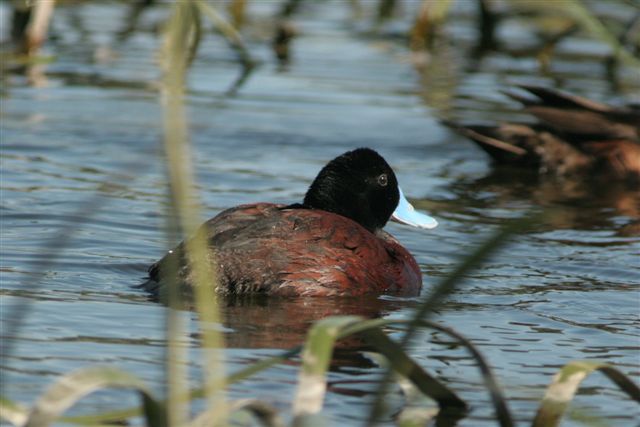
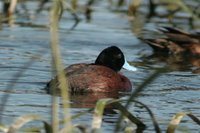 Bill & Els write : While doing some photography on a farm dam North of Richmond (in late March), a couple of Little Grassbirds began to skulk along the edge of the reed beds, followed later by a Dusky Moorhen which also hugged the edge of the reeds. Despite a three hour wait, none of the above ventured anywhere within the range of our lens. Almost having given up hope, there was a flapping and splashing rapidly approaching the hide, which in fact turned out to be
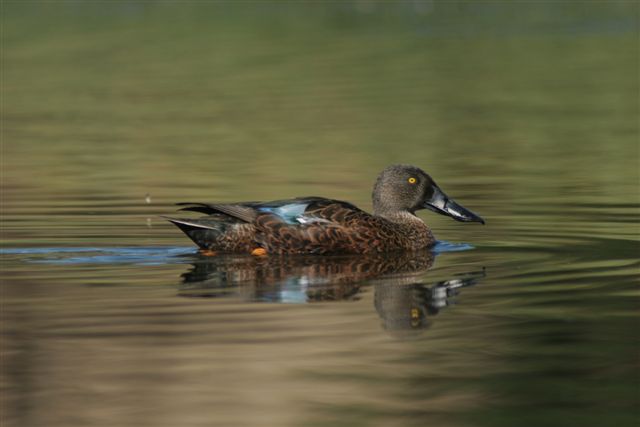
 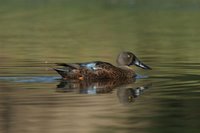 a beautiful male Blue-billed Duck. I had no idea this bird was on the small dam as it must have been hiding either in the reed mace or lying low amongst the Triglochin. After a few shots, the bird moved away, suspicious of the shutter noise. The birds' presence, signalled the arrival of several other species of wildfowl, allowing more rather nice images to be obtained. I had wondered whether the presence of a Little Falcon, in the tree above the hide, might have deterred other birds from approaching my hiding place. A very productive day resulted.
  (Top to Bottom: Blue-billed, Blue-winged Shoveler and female Chestnut Teal.)
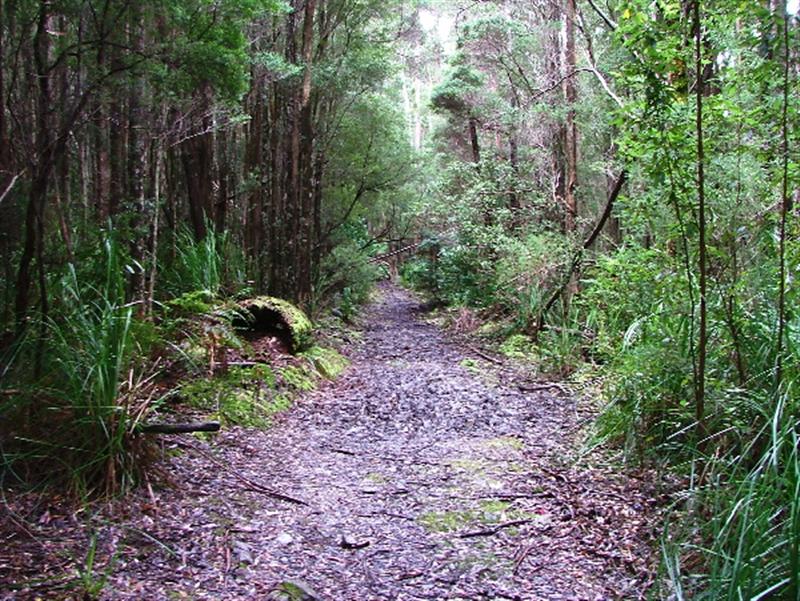
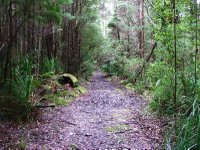 John & Shirley Tongue write: Lyrebirds were introduced into Tasmania's Mt. Field National Park in 1934, and to the Hastings Cave district, in 1945. We have heard reports of sightings at Mt. Field, but have not experienced them ourselves, though the 2005 Tasmanian Bird report cites a 2003 sighting at Lake Gordon as "an extension to its' current range". However, they seem to be flourishing in the Hastings Caves district. On a drive along the Forest Rd. between Hastings Cave and Duckhole Lake in 2003, we saw 6 individuals either in the forest, or dashing across the road.Then today (Thursday), while walking the old Lune Railway formation, which is now the walking track into Mystery Creek Cave, we heard 3 individuals calling in a very hearty fashion. As well as their own distinctive calls, these birds mimicked, Kookaburras, Black Currawong, Grey Shrike-thrushes and Green Rosellas. Sadly, no bird wanted to show itself for a photograph, though there were signs of their scratching everywhere along the sides of the track, not really obvious in the accompanying photograph.
Presumably, the Superb Lyrebird will continue to expand its' range where suitable rainforest/ dense wet sclerophyll forest habitat is available. Hopefully this will not be to the detriment of native Tasmanian ground feeding species, such as the Bassian Thrush--which did give us a fleeting glimpse today.
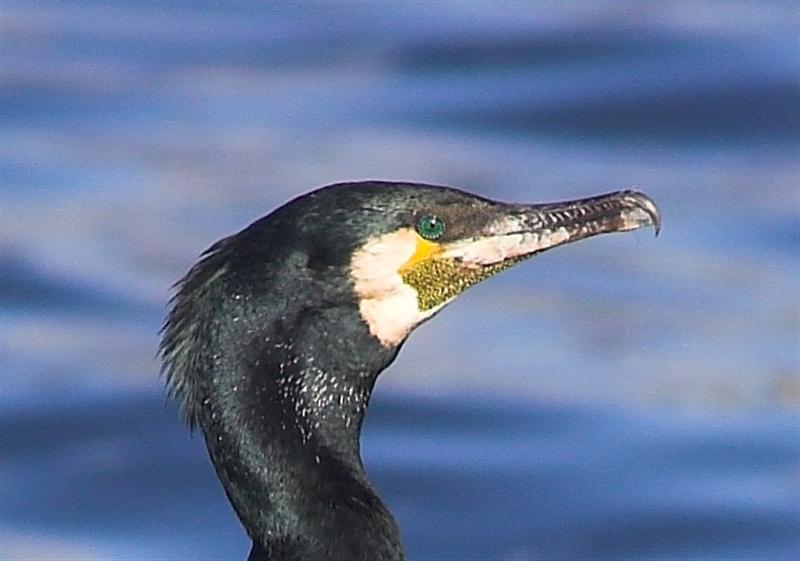
 Over the last few weeks, I seem to have photographed a considerable number of Cormorants. Without exception they have been Black-faced and Little Pieds, at least until earlier this week. While walking along the Howrah coast, I came upon a group of roosting birds, including this one and only Great Cormorant. Surprisingly, this is the first one that I have been able to approach close enough to photograph. Looking at the images on the computer, I was struck by the face colours, I obviously hadn't taken much notice before, probably dismissing these cormorants, as not particularly worthy of further inspection.
The Great, Black or Common--it seems to have had several names over the years--seems to bring out the worst in some people, from my observations over the years. They are regularly shot at, and their nests destroyed, even I might say, in National Parks ( I have witnessed fishermen doing this). But this persecution is not new. In John Gould's "Birds of Australia", published in 1865, he comments: "I killed several while perched on the high gum-trees"... and goes on "It  is, however, so shy and wary that it is difficult to get within shot of it". I guess at least he was (I assume) collecting for science! At times, large numbers (hundreds) descend on the Derwent Estuary. It is generally believed these birds emanate from the Mainland, sometimes starting calls for a bounty on them to be introduced. Investigations have shown that Great Cormorants feed on a wide variety of aquatic vertebrates and do little damage to fisheries, but long held beliefs will take a long time to change.
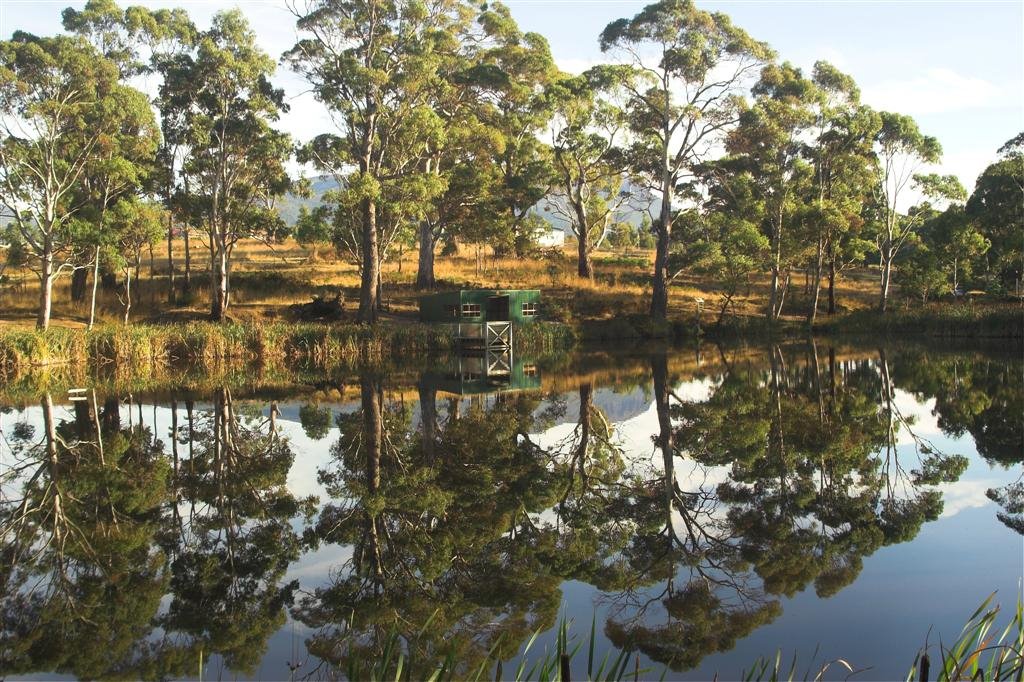
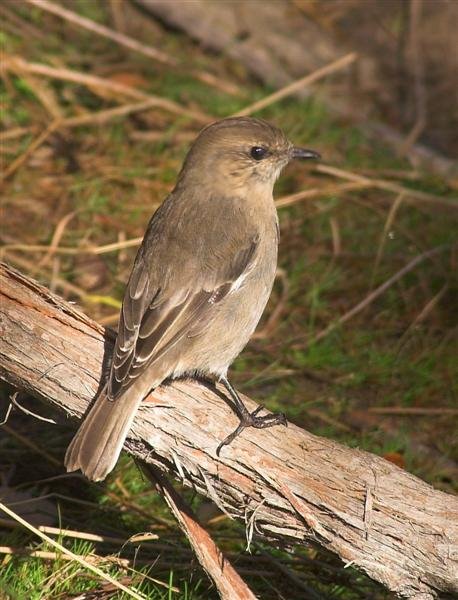
 Such a delightful autumn morning, I decided to visit the Peter Murrell Reserve at Kingston. The first frost of the year was still clearly evident as I arrived, and I set off round the lake with the expectation of a good mornings' birding. As often happens on very still mornings, there was little activity to be seen at first. I approached the second pond along Coffee Creek on the lookout for the Platypus that I have seen there on previous occasions, but found instead 2 Hoary-headed and one Australasian Grebes actively feeding. As the temperature rose--from around 2 Celsius--so did bird activit
 y. Small flocks of Black-headed Honeyeaters, few Fortyspotted Pardalotes, Green Rosellas and family groups of Dusky Robins, endemics that many visitors seek here, were evident. A few small flocks of Blue-winged Parrots flew over, as did a flock of around 20 Galahs. During my 90 minute walk, I recorded about 30 species and managed to take a few photographs too! A very satisfying early morning walk. ( The photos show the lake near the entrance and a Dusky Robin)
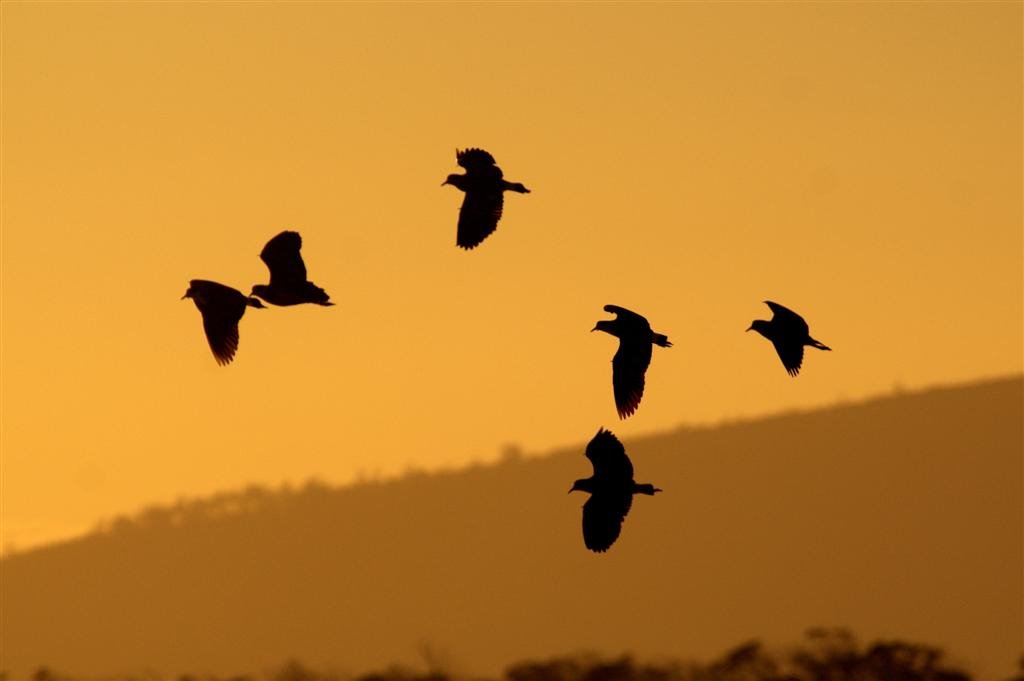
 Spurwings at Dawn
 Journeyed up to the Sandspit River, just South of Rheban, earlier this week. I haven't visited the area in several years and I was quite surprised at the changes to the river mouth. If anyone has any doubts about global warming and the effects that is having, here might be a good place to start. The dunes on the South side have all but disappeared and much of the bank edging Earlham Farm has been undermined. While I was there an inhabitant of the small coastal village was placing rock on the shore to at least slow the erosion of his property. But you may ask, what about the birds!
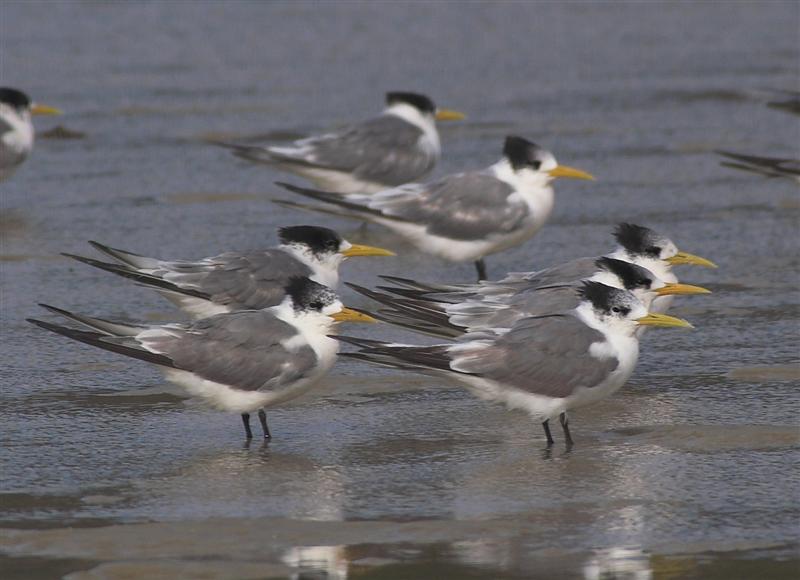 On the approach to the small coastal community, through the Earlham property, there was many Eastern Rosellas, and a few Green Rosellas, numerous Musk Lorikeets, a flock of Welcome Swallows hawking the paddocks, White-faced Herons and the usual Magpies, Miners and Butcherbirds. At the river mouth there were several Red-necked Stint (only one showing any "colour"), 4 Double-banded Plover, c.25 Red-capped Plover and a pair of Hooded Plover (pictured). I found only 3 Pied Oystercatcher, who spent most of their time playing chase, a few Pacific Gulls and a flock of around 30 Crested
  Tern (some pictured), of which at least 5 were carrying bands.