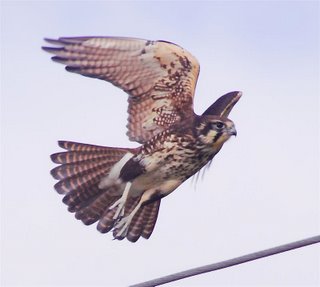
 One of the highlights of driving round at this time of year (if you're a birder) is the large number of birds that hunt from perches in the open, often power lines. On Tuesday a drive round the Cambridge/Sorell area, produced about 10 sightings of Brown Falcons, and I took the accompanying images of one of them, as it launched itself in pursuit of some Goldfinches--it was unsuccessful. Actually, the most common powerline "sitter" at the moment, is undoubtedly the Kookaburra. I counted at least two dozen, mostly loosely grouped in 2s and 3s. I didn't attempt to photograph them, maybe another day.
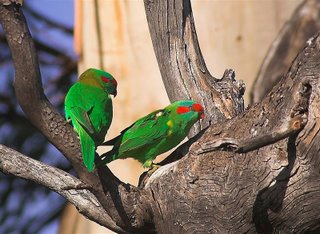
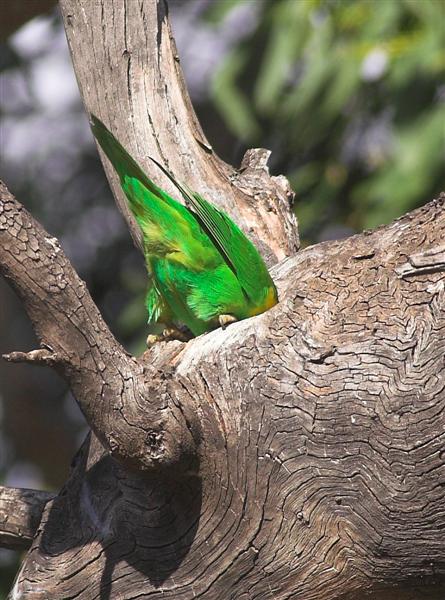
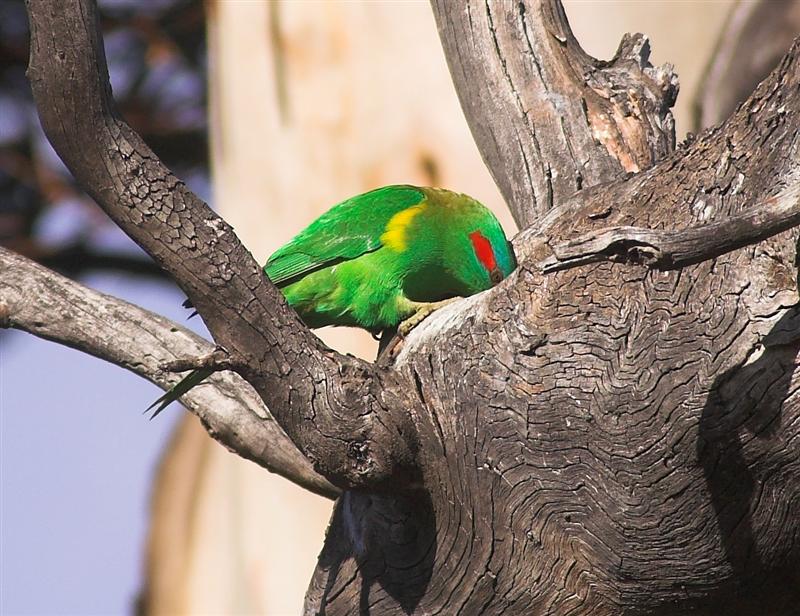
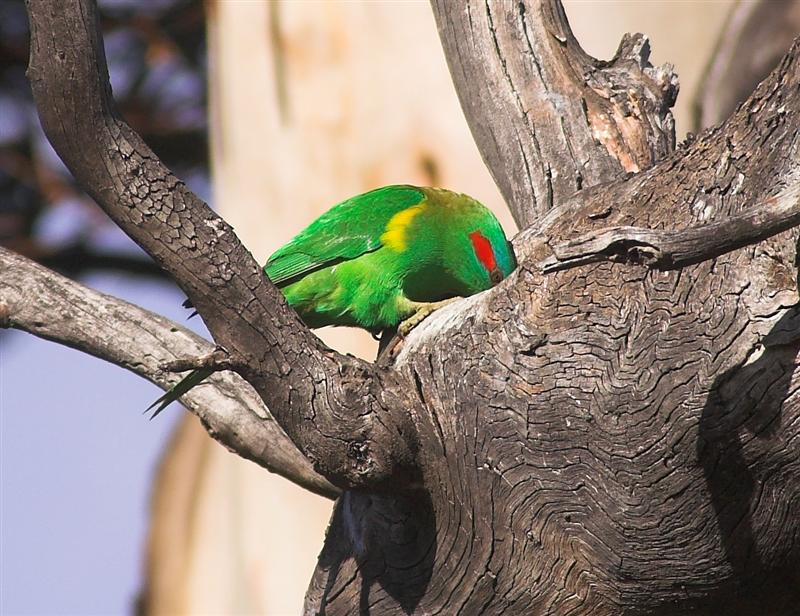
 About a week ago I noticed a pair of Musk Lorikeets taking more than a passing interest in a hole in a eucalypt while on my "constituitional" round the neighbourhood of Bellerive. Over the weekend I was surprised to see them again at the same spot and watched and took the accompanying photos.. The eucalypt is in the coastal reserve behind Bellerive Beach, and the hole is in a dead branch some 6 metres above a car park. They appeared to be cleaning the cavity out. I know little about the breeding cycle of Musks, but I would be surprised if they bred before Spring. Do they normally stake a claim to a possible site some months before they breed? Or perhaps there is some other explanation about what they were doing. They both spent many minutes within the hole and these shots were taken just before midday.
 Do you have a birding spot that whenever you approach it you get that great feeling of anticipation and excitement? Well over the years I've come to feel that way about the bridge over the Orielton Creek at the North end of Orielton Lagoon. The old bridge, a rickety, single lane wooden one, has been replaced with a concrete and steel 2 lane job. Perhaps it doesn't have the charm of the old one, but makes for easier viewing from the car! Over the years, from this bridge, I've seen such Tasmanian rarities as Marsh Sandpiper and Oriental Plover, and a battle between a Coot and a Sea Eagle, that went on for 10 minutes or more
 , before the Sea Eagle gave up. Those halcyon days, I suspect, are gone, due in part to the regime of the lagoon now making it tidal. Undoubtedly, the ever burgeoning Kelp Gull colony, is also having a detrimental effect. Despite that, it's still one of the best spots to see Egrets, Pelicans, Terns, Gulls, and a host of small waders, all without getting out of the car!
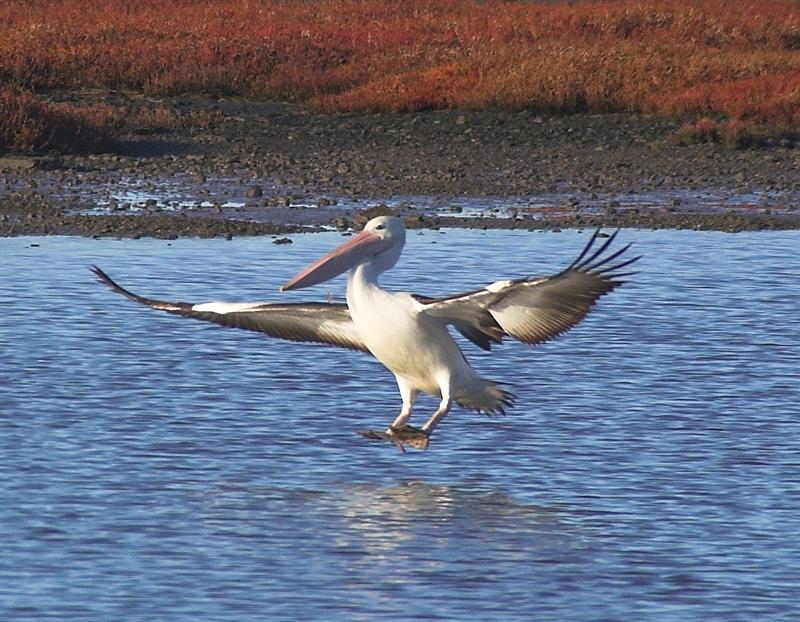
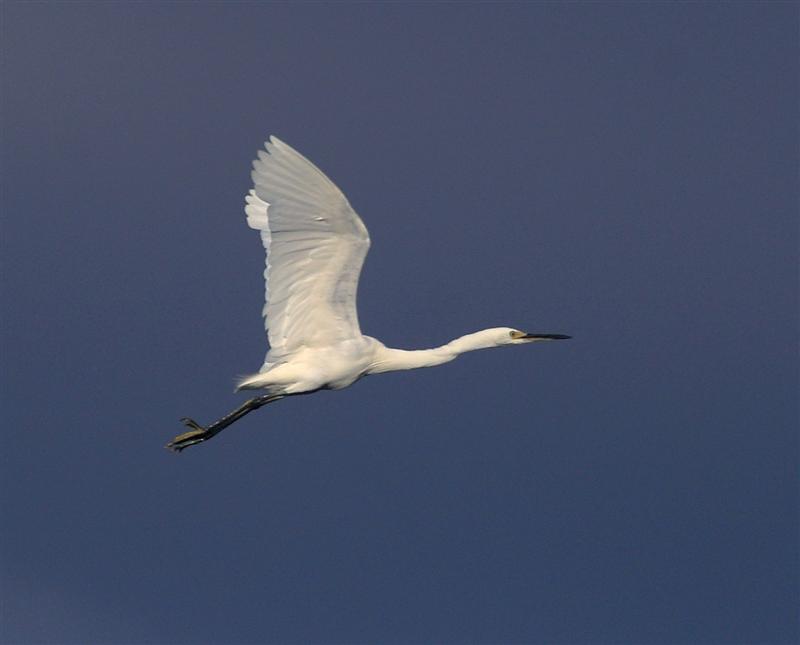
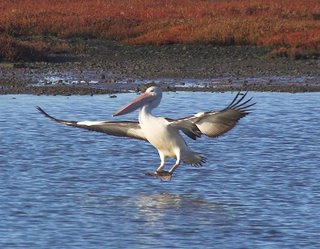
The accompanying images of a Pelican and Little Egret were both taken from the bridge earlier this month--and I did have to get out of the car to take them!
 John & ShirleyTongue write: We had a very productive day's birding on Thursday, with 65 species recorded, including one new to our Tassie list (Rainbow Lorikeet). We also saw a couple that we've only rarely seen here--Australian Hobby and Royal Spoonbill. The total was given a flying start at the large dam at the Forcett Lakes Golf Course. Walking around this dam we recorded 41 species on it, or nearby. This included at least 28 Australian Shelduck (see accompanying photo). We are not used to seeing such large numbers in the South of the state. Over 20 came soaring in together, swaying and circling, with very noisy wings. (Ed. I think this is known as "whiffling") One of them appeared aberrant in colouring, unless it was a juvenile. However, none of our books listed this colour pattern for juveniles. It seemed just like the rest, only it had a buff coloured chest, instead of the normal rich chestnut. Sadly, it was too distant to get a decent photo.. Has anyone else seen Shelducks with this colouring?
[ The Forcett Golf Course is on the right, a short distance down the Lewisham Rd, off the Arthur Highway, South of Sorell.]
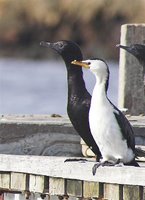
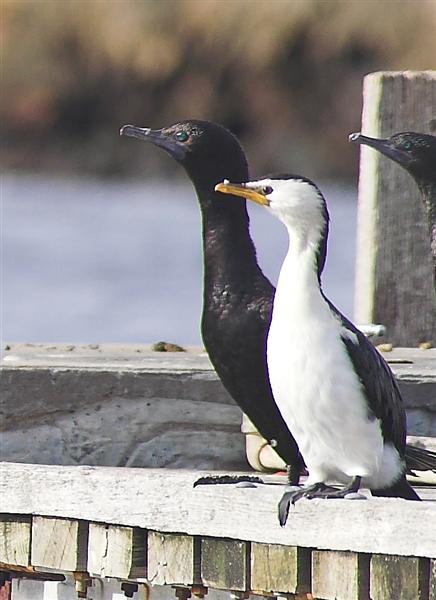
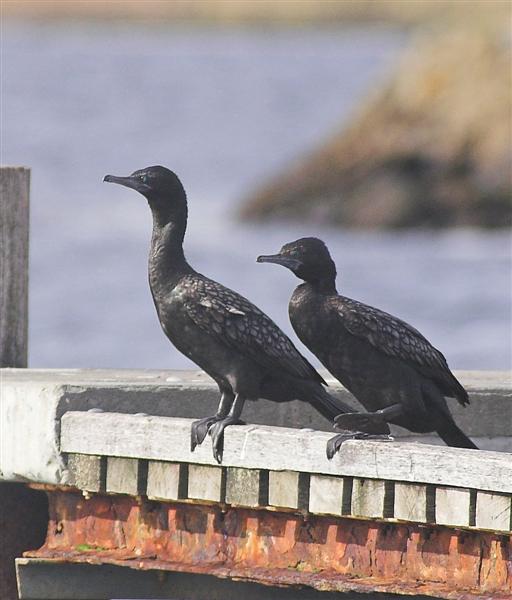
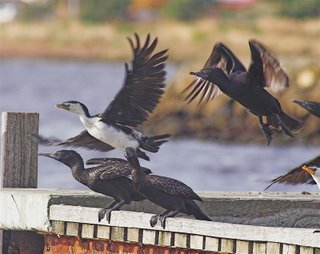 Excepting the Pied Cormorant, which is a rarely seen species in Tasmania, the scarcest cormorant here is the Little Black. I suspect it's often overlooked, particularly when roosting with other cormorants. Most often seen in estuaries, although sometimes found on larger farm dams. Around the Hobart area, there are usually small groups to be found in the Derwent Marshes, roosting on the beached dead trees.
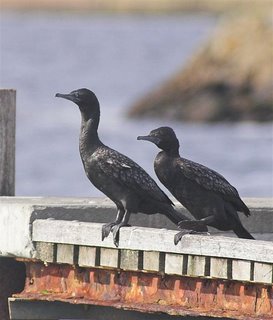 Other sites include Blackman Bay (Dunalley area), where occasionally flocks reach around 70 birds. I'm sure they don't usually generate great excitement among birders, but perhaps you haven't seen them cooperatively feeding. I've witnessed this feeding method at close hand a few times, and their ability to "herd" fish and the subsequent feeding frenzy, makes for exciting viewing. Occasionally, Little Pied and Great Cormorant join in.
The images shown here, were taken at Montrose Bay (on the Derwent River) recently, on the yacht club jetty. One of the shots gives a comparison of size with a Little Pied.
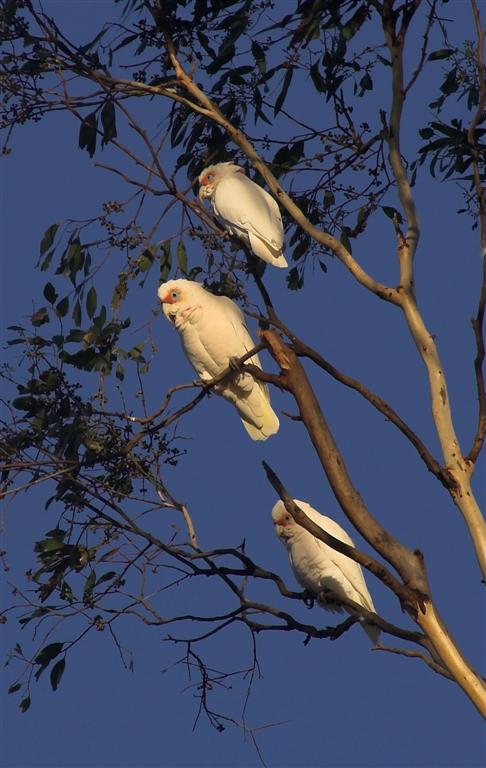
 I was on my way to Maydena this morning when I came upon one of the Sulphur-crested Cockatoo flocks, this one at Plenty (just North of New Norfolk). The flock numbered around 400, I would guess, and was spread out over several kilometres. I stopped to photograph a group in tall eucalypts close to the road--surprised they let me get that close! I then realised that among the Sulphur-crested were a 'sub flock' of about a dozen Long-billed Corellas. I think this is the first time I've had more than a fleeting, distant view of them in Tasmania. I gather they have had a substantial increa
 se in population in Victoria, and are well established in the Northern Midlands of Tasmania. Probably closer inspection of Sulphur-crested flocks will throw up more records. I didn't get a count of the total numbers of Corella, but saw at least 20.
 John & Shirley Tongue write: We don't often come across Dusky Moorhen in Tassie--though I hear they are consolidating and expanding their range. One exception is at the New Norfolk Sewerage Treatment wetlands, where we have seen them a couple of times. Today (Thursday) was no exception, though we did only see the one bird (accompanying pic), and that a juvenile, as evident by the dull bill.
{Editors note: Back in the '70s they were commonly seen at the old Launceston Tip site (built on a wetland!). A slow increase in numbers around the state, especially in the North of the state, since then. Once, the numbers fluctuated, and it was assumed these represented birds from the Mainland, but Moorhen certainly now breed here. Common on King Island}
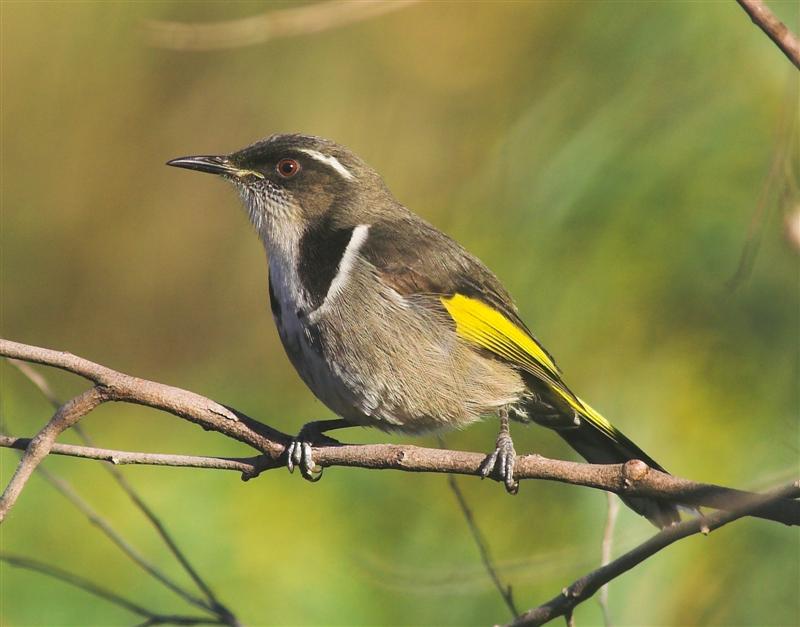
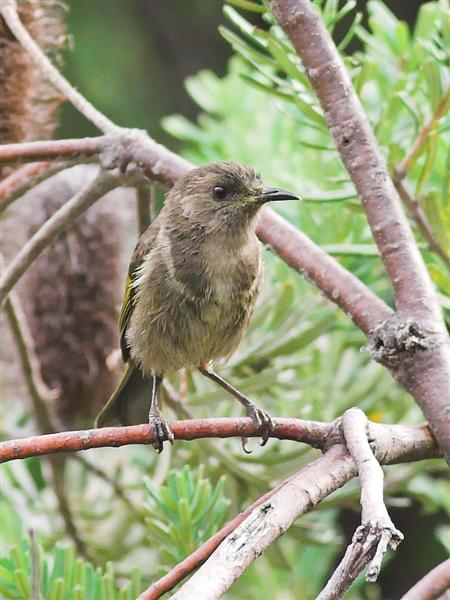
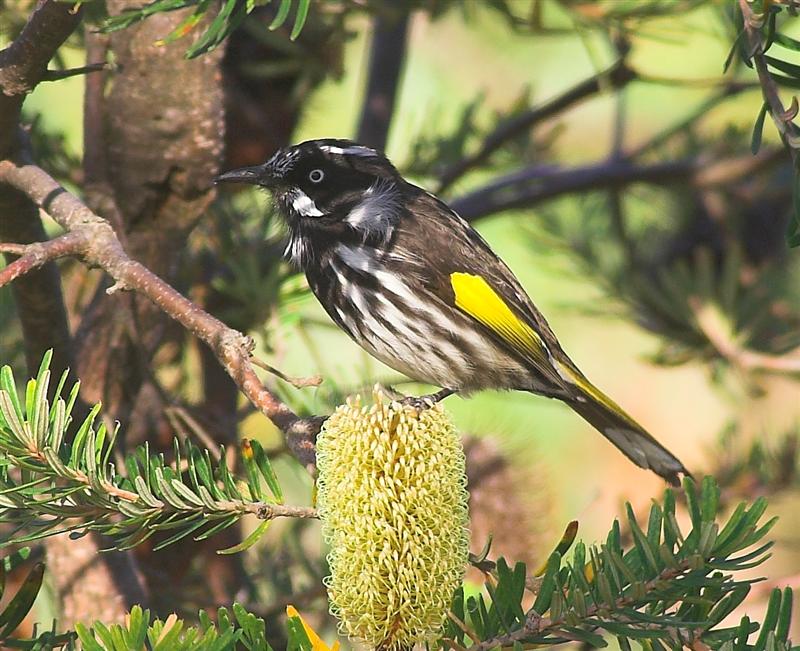
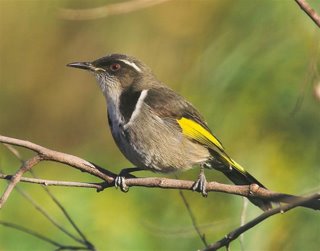 Having failed to get any shots of the Crescent Honeyeater earlier in the week, I went back to Cape Deslacs Reserve (Clifton Beach) this morning to try again. With a bit of luck and perseverence, I finally managed to get some useable shots. I staked out a couple of Banksias with the hope that eventually one of the males would turn up, and while waiting, a male came and sat on the branch of a eucalypt quite nearby. Sometimes things go my way! Although both male and female Crescents were feeding on Banksia blossom, I noted that both were catching
 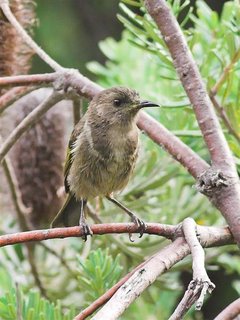 insects too. As the morning wore on, the males spent more time chasing each other, and rarely spent more than a few seconds on the Banksia flowers--time to pack up and hope that the shots are OK. This was one of the few times I had seen so many female Crescents, certainly in my garden they are distinctly rare visitors, whereas the males are common, ( but frequently hassled by the Little Wattlebirds).
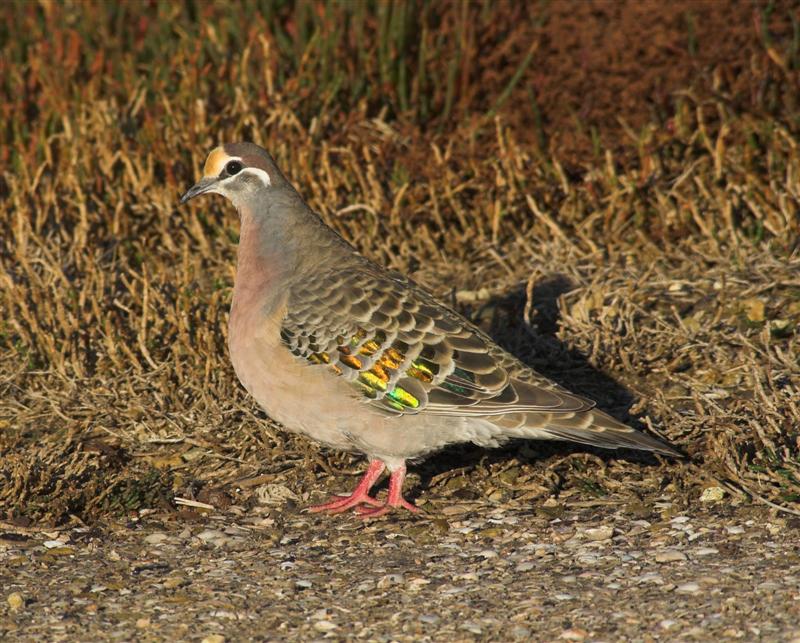
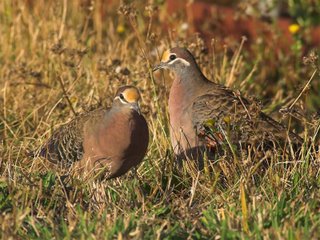
 I returned to Clifton today, a still, sunny morning, and much to my surprise I found more Common Bronzewings. I took the accompanying shots of Bronzewings in someones' front garden, along Bicheno St.. In total there were 8 birds, and very approachable, presumably because they have got used to the to and froing of locals. So despite having blogged Bronzewings a few days ago, I thought these shots were worthy of publishing and better show the birds exquisite plumage.
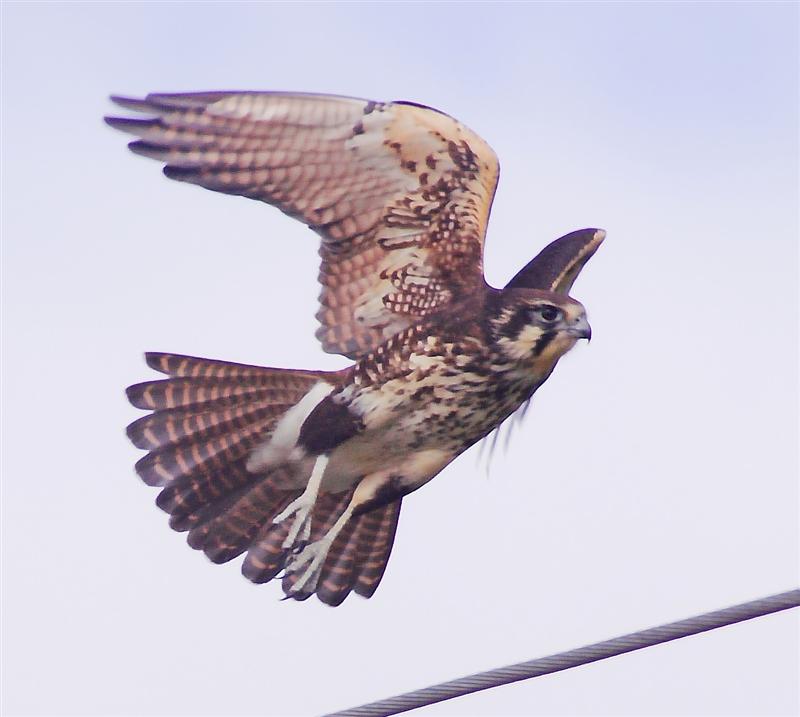 One of the highlights of driving round at this time of year (if you're a birder) is the large number of birds that hunt from perches in the open, often power lines. On Tuesday a drive round the Cambridge/Sorell area, produced about 10 sightings of Brown Falcons, and I took the accompanying images of one of them, as it launched itself in pursuit of some Goldfinches--it was unsuccessful. Actually, the most common powerline "sitter" at the moment, is undoubtedly the Kookaburra. I counted at least two dozen, mostly loosely grouped in 2s and 3s. I didn't attempt to photograph them, maybe another day.