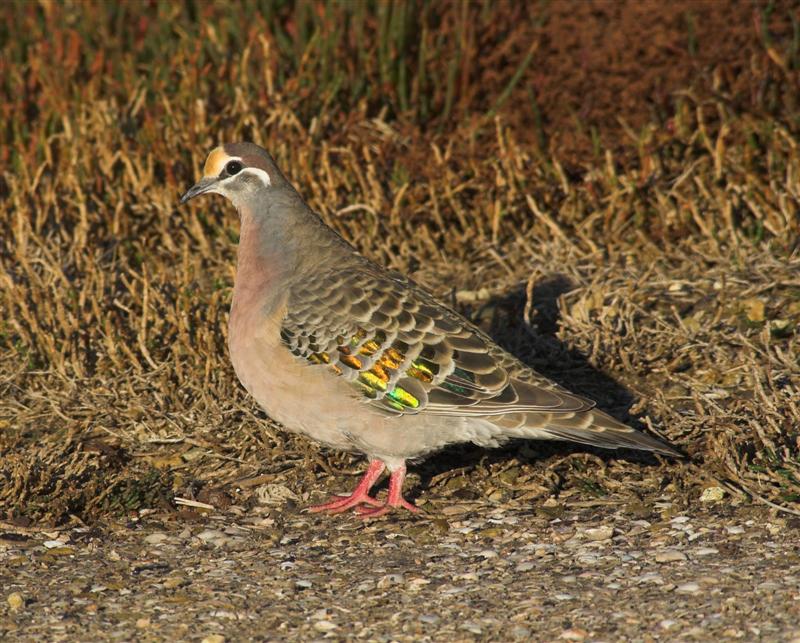
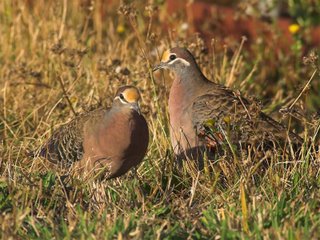
I returned to Clifton today, a still, sunny morning, and much to my surprise I found more Common Bronzewings. I took the accompanying shots of Bronzewings in someones' front garden, along Bicheno St.. In total there were 8 birds, and very approachable, presumably because they have got used to the to and froing of locals. So despite having blogged Bronzewings a few days ago, I thought these shots were worthy of publishing and better show the birds exquisite plumage.
 This morning was one of those days that I should have stayed in. It was windy, very overcast, and not the sort of day to be birding, and definetly not a day for bird photography. I drove round most of the local traps, and was returning from Pipeclay Lagoon along Clifton Rd., when I noticed what I assumed was a Turtle Dove on the wires. I slowed as I passed for a positive ID, and realised it was a Common Bronzewing--U-turn--time for a couple of pix! I don't get the chance to photograph them that often and although the wire doesn't add anything to the shot, at least I got it.
Back in the '70s I regularly birded the South Arm Peninsula, and on one memorable morning, found 8 Common Bronzewing (and 2 Beautiful Firetail) nests. The Bronzewings were amongst the more common birds in the light timbered sandy heath behind Mortimer Bay. Today, with the area having been sub divided into 5 acre blocks, most of the Bronzewings have gone. At least I still have my memories.
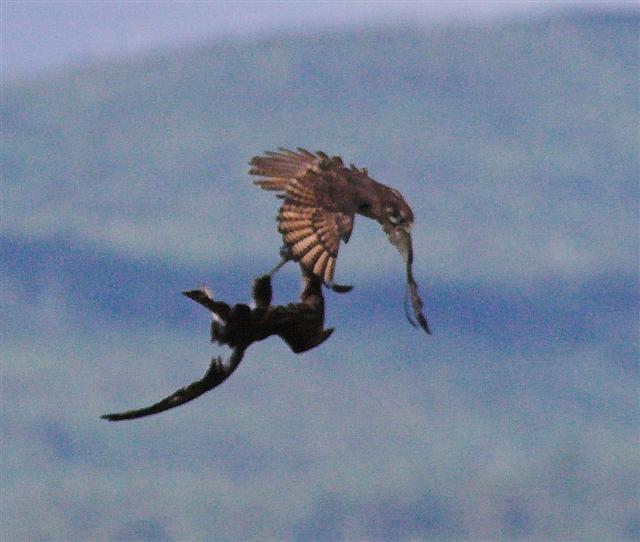
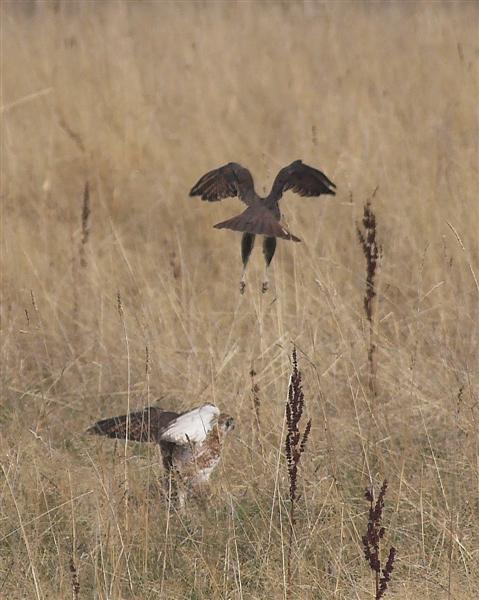
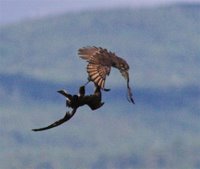 I was down at the Peter Murrell Reserve this morning and after a fairly lack lustre morning as far as birding goes, wandered back towards the car park on the Western side of Coffee Creek, a route I had not taken before. As I neared the 2nd pond, there were loud, very agitated calls, that I recognised as a Brown Falcon's. I headed away from the trees hoping to get a view, and possibly photograph, the pair of falcons as they wheeled, calling, just above the trees. As I did so, I saw another 'Brown', heading towards me across open paddocks. The calls from the wheeling Browns at this stage reached fever pitch! As the
 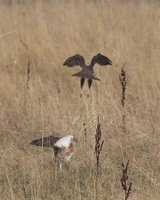 interloping Brown approached it was attacked at a speed a Peregrine would have been proud of and certainly much faster than I've ever seen a Brown Falcon fly at. The two falcons locked talons as you can see in the rather poor quality photo., and fell to the ground. They landed in a heap, disentangled, and the interloper flew off
.
The triumphant bird returned to its' mat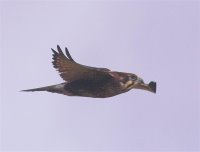 e in the trees near the pond. The whole episode had taken a matter of seconds, and I was torn between trying to photograph it and just watching a thrilling event. I did neither well! and the images don't do the event justice, but I did feel as I wandered back, that the morning had proved to be very satisfactory. I hope the photos capture at least some of the excitement.
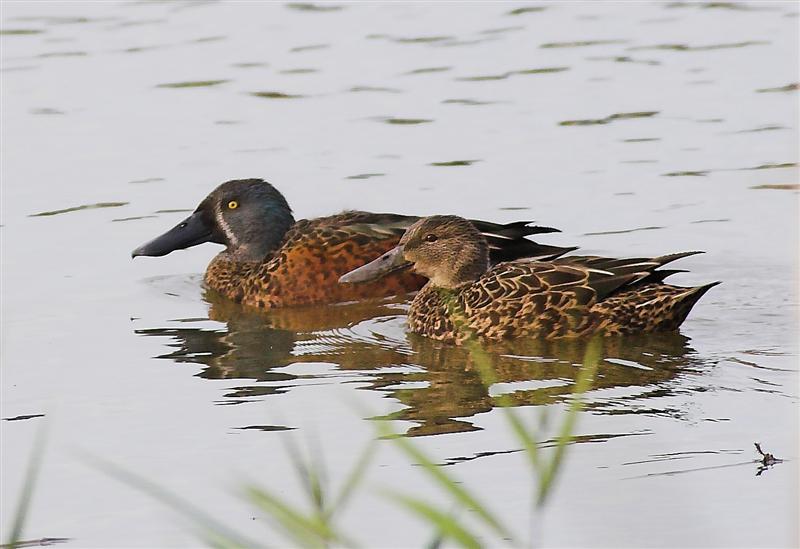
 I visited Gould's Lagoon at Granton this morning. With a strong wind blowing and the lagoon pretty full, the numbers of wildfowl were reduced. Small numbers of Chestnut Teal and Black Duck were present, as were about 10 Blue-winged Shoveller. As I watched a group of Shoveller, I realised there was a single male Whiteyed Duck, or perhaps I should more correctly call it a Hardhead, among them. I managed a quick "shot" of it, before they all headed away from the public hide. Because of the high levels present I noticed that the Shoveller were using a different feeding technique. While they mainly swam with their bills in the water filter feeding, some of them were diving, sometimes for more than 10 seconds at a time. While I have often watched "dabbling" ducks dive at the sig
 ht of predators (hawks), I think this is the first time I had seen Shovellers diving to feed (perhaps the Hardhead was giving lessons!)
.
Other species present includedLittle Pied and Great Cormorants, Swamphens, Native Hen, Kelp Gulls, Coot and Little Grassbirds. There appears to be good numbers of Shoveller about at the moment, with at least 80 at Granton Reserve and 40 at the Orielton settling ponds.
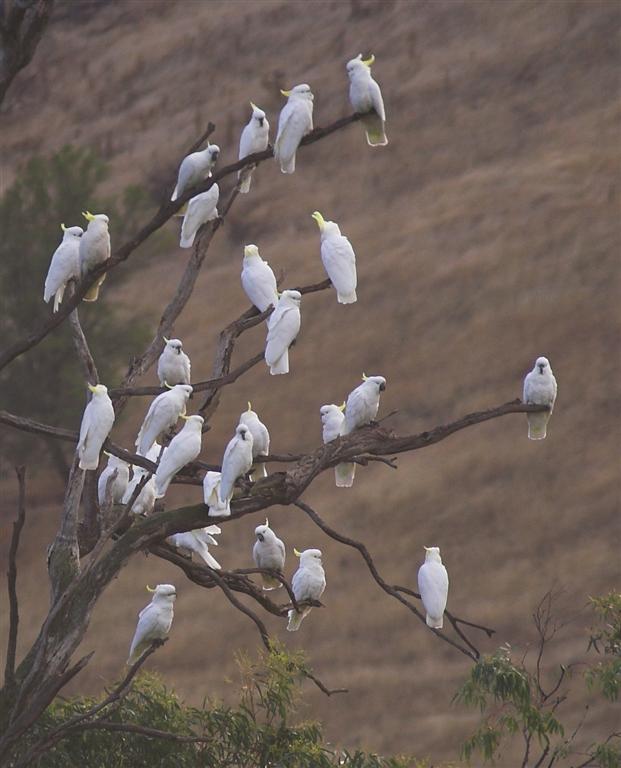
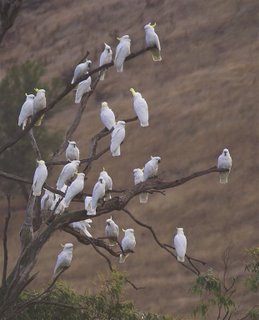 That was the name John Gould called the bird that most of us call simply "Sulphur-crested" and arguably, after the Kookaburra, the most widely known Australian bird. On my recent trip "In Search of Cattle Egrets", the most commonly seen bird was undoubtably these Cockatoos, and when you are looking for white birds in paddocks (egrets), they can make for a frustrating search! Gould mentions the farmers dislike of these birds (he's writing in the 1860s) and comments "it is consequently hunted and shot down wherever it is found, a circumstance which tends to lessen its numbers." One imagines it would!!
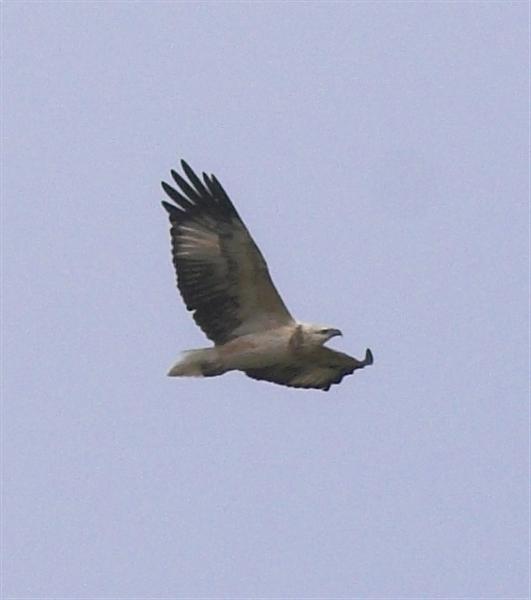
I found large flocks in the Broadmarsh and Meadowbank area, but the biggest flock appears to be in the Ouse area. I set off from Ouse on the Osterly Rd., looking for egrets, and shortly came across a large 'cloud' of Cockatoos rising above the trees and calling noisily. I assumed they had been disturbed by farming operations, but as I turned back towards Ouse, I saw the 'culprit'--a Wedgetailed Eagle, just close enough to  photograph. All the Cockatoos stayed in the trees until the Eagle had disappeared into the distance. The flock here appears to number at least 800 birds, and the other 2 flocks mentioned,are in the 2-300 range. Coincidentally, I came across another Wedgie in the Meadowbank area, on the way back. Although I've watched many Wedgetails over the years, I still stop and watch these magnificent flyers whenever possible.
 From Bill& Els: Just received an e-mail from a friend on Flinders Island who reports picking up an immature White-headed Pigeon on Palana Beach. Apparently it had some "interesting items" in its' crop, which had been torn open. The bird has been lodged with the Queen Vic Museum.
NB The White-headed Pigeon is found along the coastal strip of NSW and Queensland. Bill tells me he took the accompanying pic. at the Melbourne Zoo.
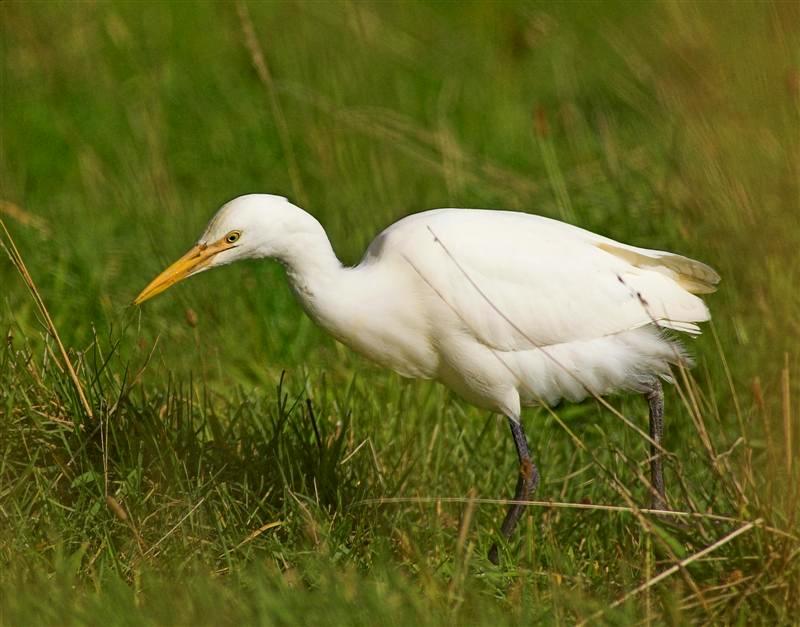
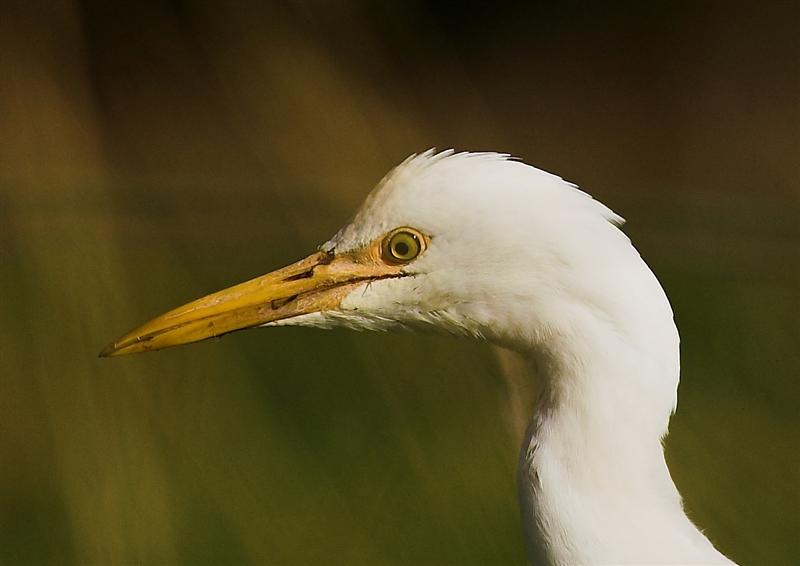
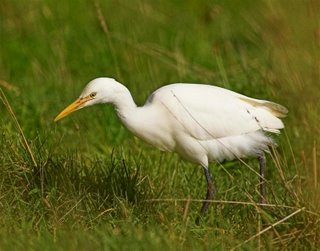 On a cool, if not cold, morning, I went in search of Cattle Egrets. I'd decided on a search of the Broadmarsh area, North of Brighton, as a possible spot and I did indeed find some. Not exactly a lot, I think the total for the entire valley was around 15, divided into 3 flocks. The biggest group of 10, were feeding with horses, another of 3 with cattle and the remaining 2 with sheep. I moved on to Hamilton and Ouse and got a big fat zero! An area that in the past would have had flocks totaling 50+ birds. On the trip back to Hobart, I drove via New Norfolk and there on the outskirts of the town--voila!--20+ Cattle Egrets, this time feeding with cattle--time for photography.
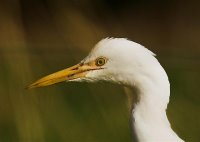 Back at the time of the first Atlas, we confidently predicted, that in a few years, we would be recording Cattle Egrets breeding, certainly on King Island, and most probably in the coastal areas of the North West of Tasmania. I suspect the prolonged drought on the Mainland, has reduced numbers and that we might have to wait a good while longer, although the North of the state still records large Wintering flocks.
 To join the Cockatoos on the other side! Well that's not really why, but a morning excursion which included Montrose Bay, threw up a couple of interesting sights. One was the 50 plus Pied Oystercatchers feeding on the Rosetta High playing fields, prepared to put up with children, pedestrians and traffic to cross the road from their roost site on the shores of the Derwent River. The other was seeing the Oystercatchers feeding alongside the Sulphur-crested Cockatoos. At first I thought that many of the Oystercatchers were juvenile (having a dark tip to their bill), but real
 ised that this was the result of feeding in wet ground! I imagine for locals this is a common sight, but I found it quite novel.
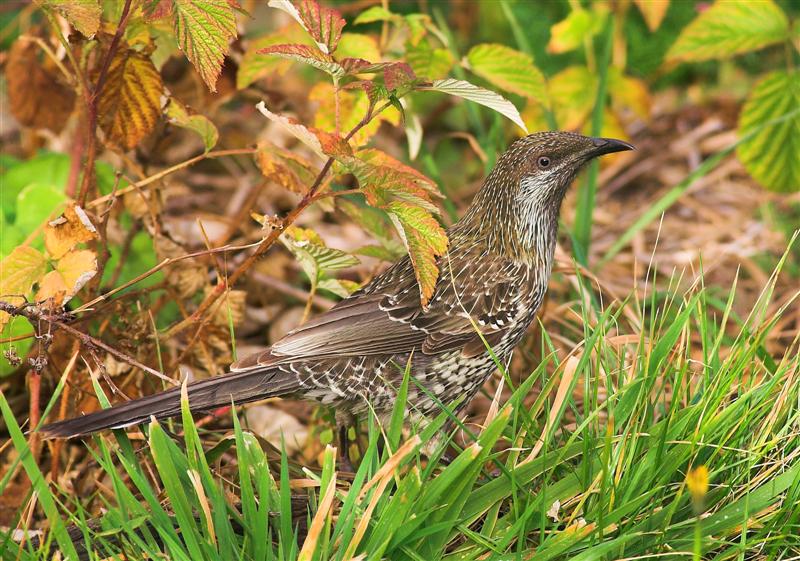
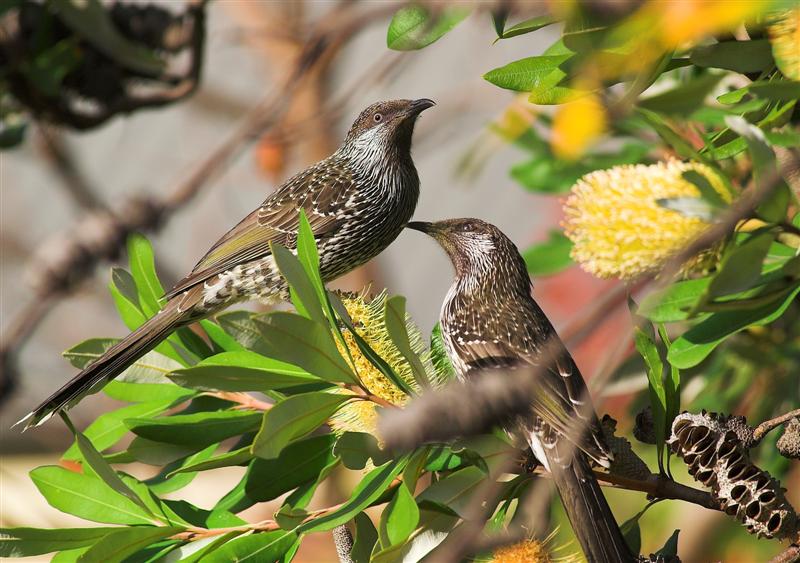
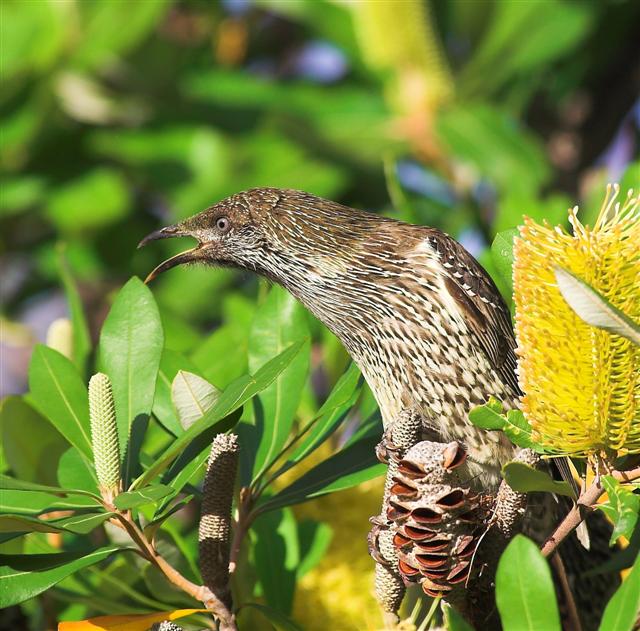
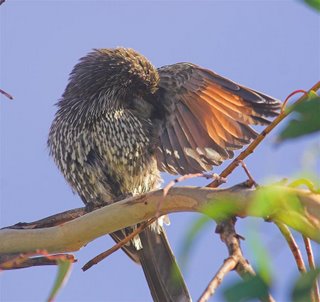 I spend a great deal of time watching Little Wattlebirds in my garden. It's not so much that I do it consciously, more because they're always there. They breed almost the whole year long, and they're very protective of their "patch" and their young. At the moment they have their work cut out, with flocks of Musk Lorikeets on the flowering euc. leucoxylon. But the point of this posting is to recall some strange antics of a LWB recently.
The frequent snapping of its' bill by a LWB drew my attention to it. It sat as per image at left, preening, but obviously catching very small flying insects disturbed from its' plumage as it did so. Shortly after, it flew to the top of a melaleuca and with wings open, dragged itself through the foliage. It then flew back to the original perch and repeated its' earlier 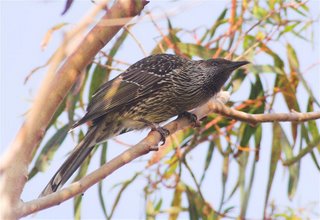 performance of catching insects as it preened. I'm not sure whether it was garnering insects to eat in a rather novel way, or using the insects as part of the grooming process. Either way, I don't recall ever see this process in LWBs or any other species. Can anyone shed any light on this behaviour?
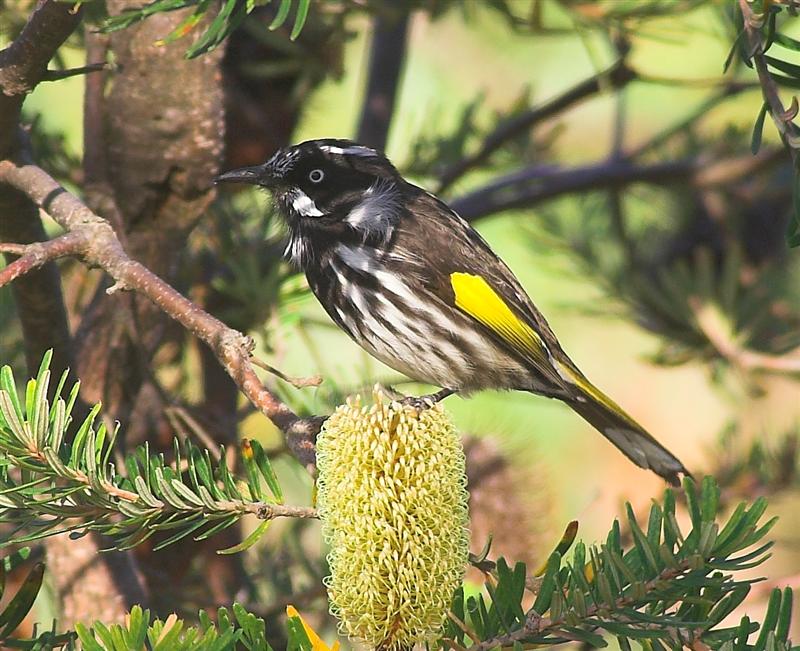 As mentioned in an earlier blog, I visited Clifton Beach over the weekend, and more specifically, the Cape Deslacs Reserve. Most of the reserve is coastal heath, with light timber in some areas. At the moment the Banksia marginata is flowering profusely and attracting a range of birds, especially honeyeaters. In an hour or so, I recorded 24 or so species. They included a flock of 9 Yellow Wa
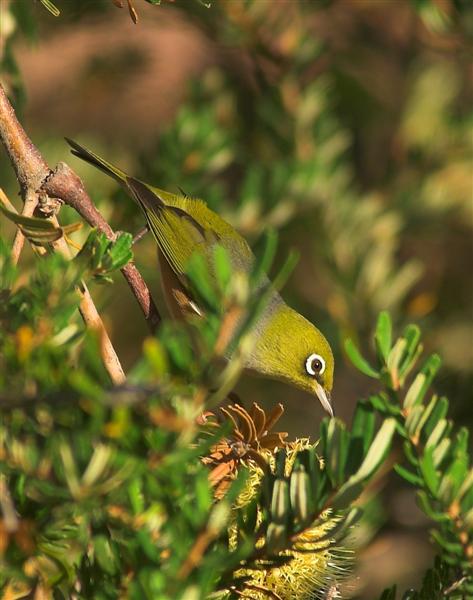 ttlebirds, a solitary Blue-winged Parrot, Golden Whistler and c40 Yellow-tailed Cockatoo. The commonest birds on the banksias are the Crescent and New
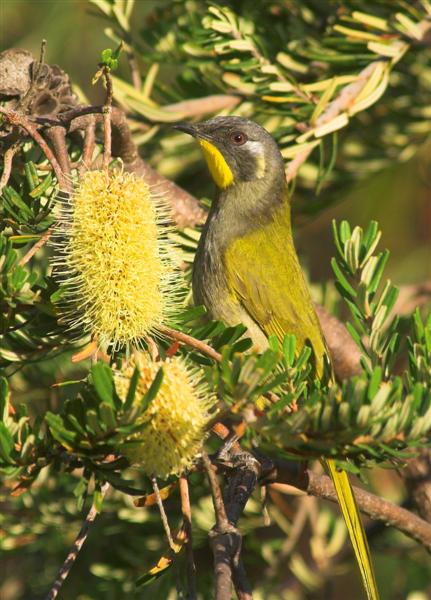 Holland Honeyeaters and Silvereyes. The accompanying photos were all taken of birds in a single banksia--I was really after the Crescents,