Barbara Boyle sent the following recent Tullah sightings:
Pair of Great-crested Grebes,
Pair of Scaly-breasted Lorikeets bathing in our frog pond (a significant record if they are not aviary escapes),
Pair of Collared Sparrowhawks-- a wildlife carer lost a fully recovered Ground Parrot from a cage to one of these 6 weeks ago.
Pair of Bassian Thrushes living in our garden
Tuesday, January 31, 2006

Blackbird Blitz !
John Tongue writes:
While repairing damage done to my garden recently, I was "inspired" (?) to pen the following literary masterpiece:
While being enamoured of things ornithological,
I am also quite partial to things horticultural,
So a Blackbird you see,
Holds no attraction for me,
But evokes, rather, thoughts pathological!
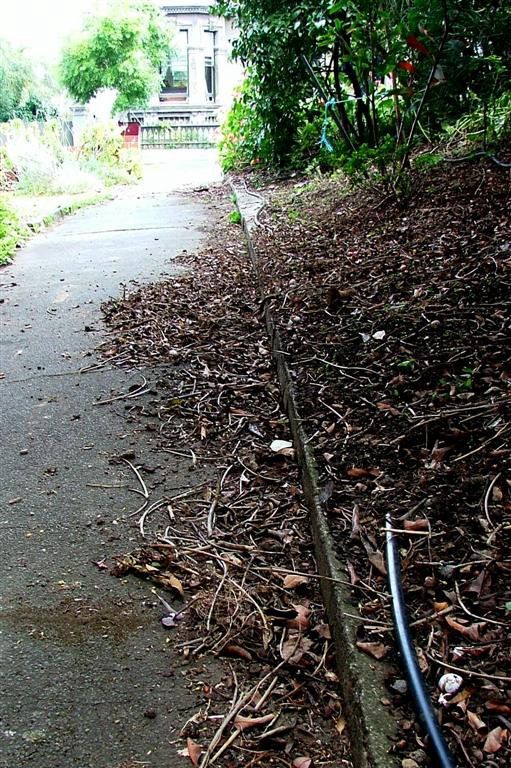
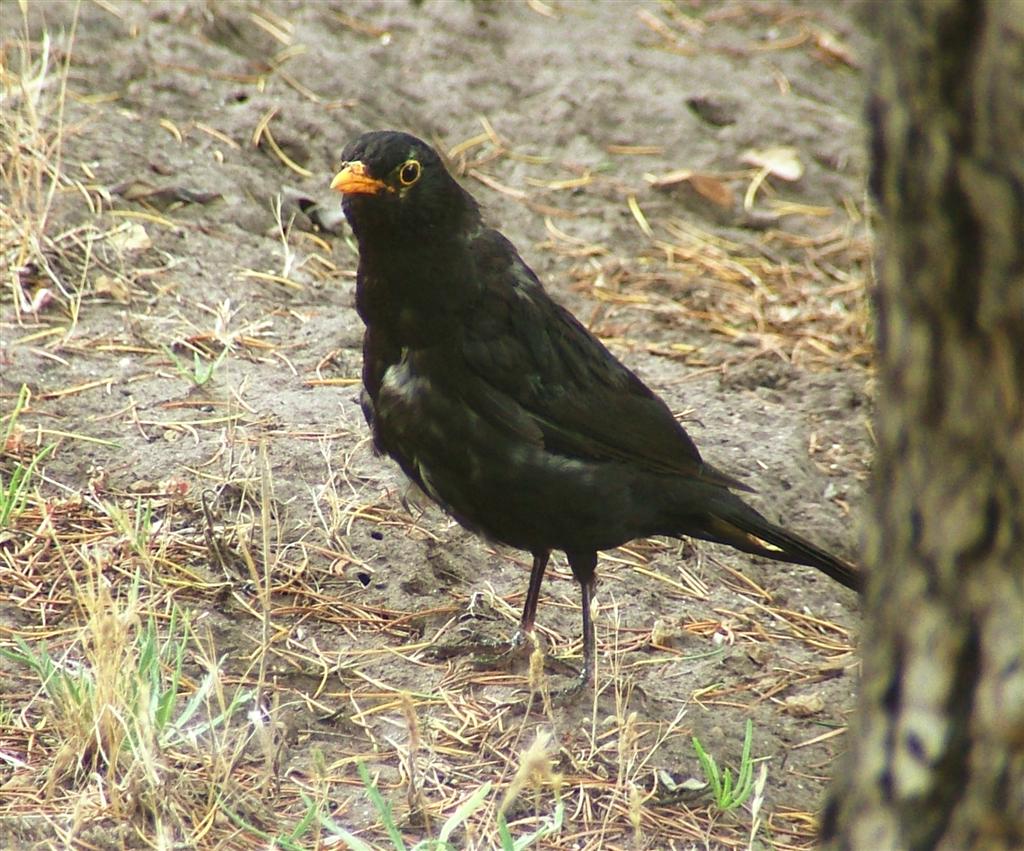
Accompanying pix show some of the damage and one of the scruffy culprits.
While repairing damage done to my garden recently, I was "inspired" (?) to pen the following literary masterpiece:
While being enamoured of things ornithological,
I am also quite partial to things horticultural,
So a Blackbird you see,
Holds no attraction for me,
But evokes, rather, thoughts pathological!
Accompanying pix show some of the damage and one of the scruffy culprits.
Dust Baths
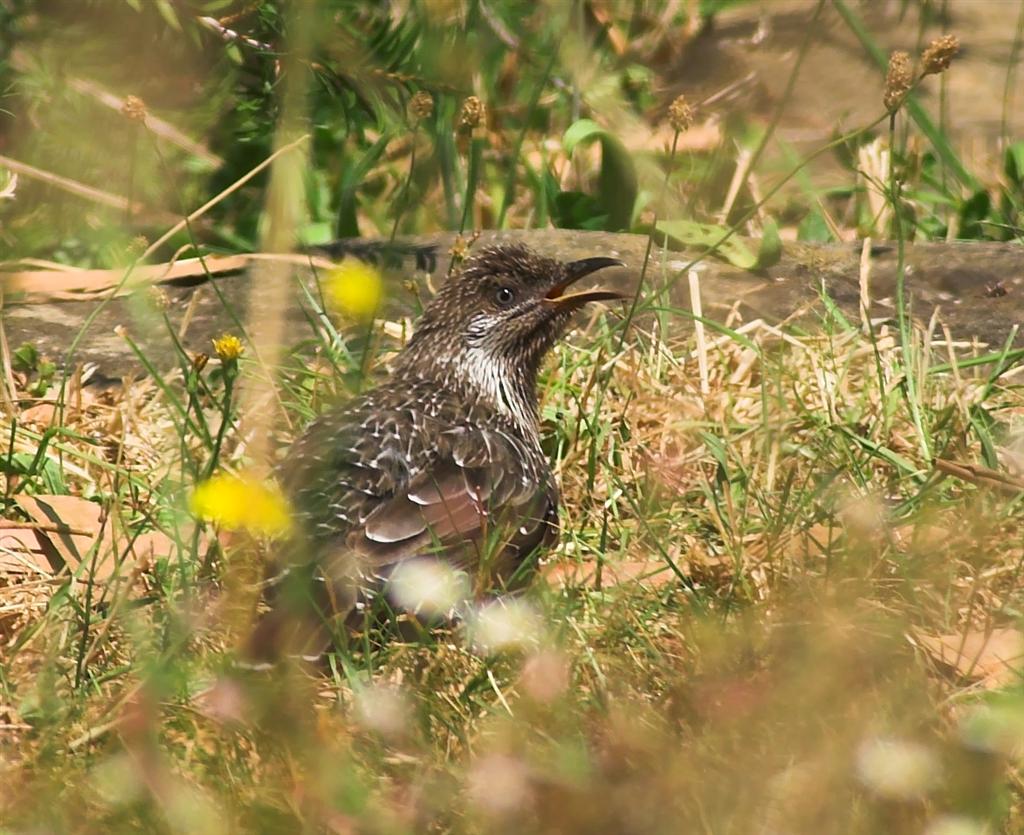 I noticed recently a number of birds taking dust baths. The reason birds indulge in this practice appears, at least in the literature, to be potentially diverse. On the day I photographed this Little Wattlebird (in my garden) the temperature was over 30C and the bird looked, as you can see, somewhat stressed, suggesting that it enables them to cool down, although it's not clear how this works. Has anyone a pet theory what the true purpose of this practice might be?
Monday, January 30, 2006
Who the Hell was Horsfield anyway...?
I expect you're wondering who Horsfield was? Well, I'm going to tell you anyway! You'll be pleased to know this is the 'potted' version.
Thomas Horsfield (1773-1859) was an American hailing from Philadelphia. He trained as a medical doctor and visited Java while in the American Navy working as a ship's surgeon. He was very taken with Java and returned there to work and pursue his interest in Natural History. He collected insects and flowers and wrote several scientific papers on the subject. Later, when Java came under the control of the British, he collected for Thomas Raffles of East India Company fame. (I was surprised to come across a statue of Raffles in the Bogor Botanical Gardens--just South of Jakarta--by the way a great place to birdwatch). I digress. In 1819, ill health caused him to travel to London, where he became keeper and curator of the East India Co.'s museum. He was a founder member and Assistant Secretary of the Zoological Society of London. There he, together with Nicholas Vigor's, classified a number of birds, including many Australian species in the Linnaean Society's collection and together wrote a paper on the subject. I'd like to think that he noticed a difference in the plumages of the bronze cuckoos and for his efforts the species was named after him, but that's conjecture. He also had a tortoise and a hawk named after him.
The wonders of the internet! Aren't you glad that's the potted version!
Thomas Horsfield (1773-1859) was an American hailing from Philadelphia. He trained as a medical doctor and visited Java while in the American Navy working as a ship's surgeon. He was very taken with Java and returned there to work and pursue his interest in Natural History. He collected insects and flowers and wrote several scientific papers on the subject. Later, when Java came under the control of the British, he collected for Thomas Raffles of East India Company fame. (I was surprised to come across a statue of Raffles in the Bogor Botanical Gardens--just South of Jakarta--by the way a great place to birdwatch). I digress. In 1819, ill health caused him to travel to London, where he became keeper and curator of the East India Co.'s museum. He was a founder member and Assistant Secretary of the Zoological Society of London. There he, together with Nicholas Vigor's, classified a number of birds, including many Australian species in the Linnaean Society's collection and together wrote a paper on the subject. I'd like to think that he noticed a difference in the plumages of the bronze cuckoos and for his efforts the species was named after him, but that's conjecture. He also had a tortoise and a hawk named after him.
The wonders of the internet! Aren't you glad that's the potted version!
A Horsfield's Bronze.
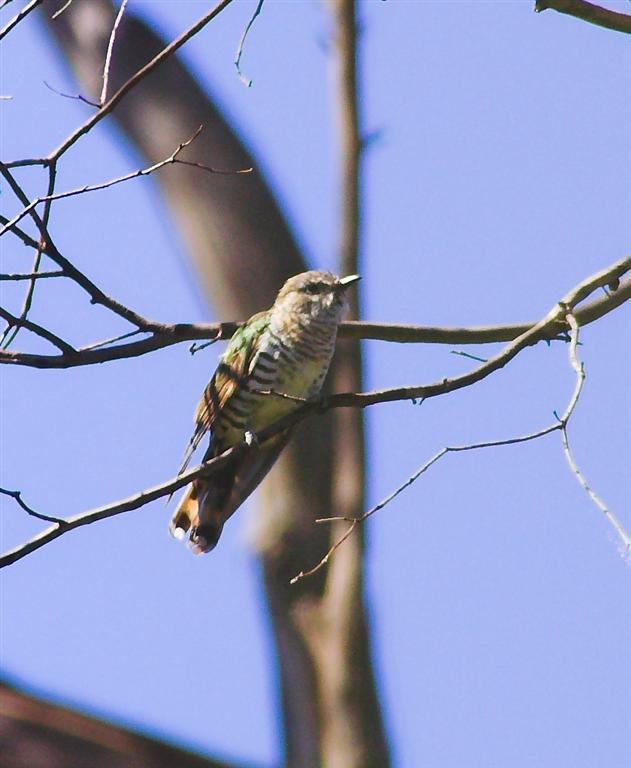 While busily engaged photographing the Dusky Woodswallows in the Peter Murrell reserve recently, I noticed out of the corner of my eye, another bird in the same tree. It was fairly non descipt with the naked eye, but in a lull in the action, I pointed the camera at it. I was surprised to see it was a Horsfield's Bronze Cuckoo. I managed to get a couple of shots off before it took flight, leaving me to curse about not noticing it earlier and allowing me to get better shots. Generally speaking I've been aware of the presence of Bronze Cuckoos by their call, which is mainly given in Spring and early Summer. Horsfield's seems to prefer drier areas than the Shining and I have regularly caught them while banding, in fairly dense acacia. At Seven Mile Beach, around the airport, I have regularly found them during the Winter in this habitat. Both Bronze Cuckoos are mainly Summer migrants to Tasmania
Saturday, January 28, 2006
Bad Hair Day?
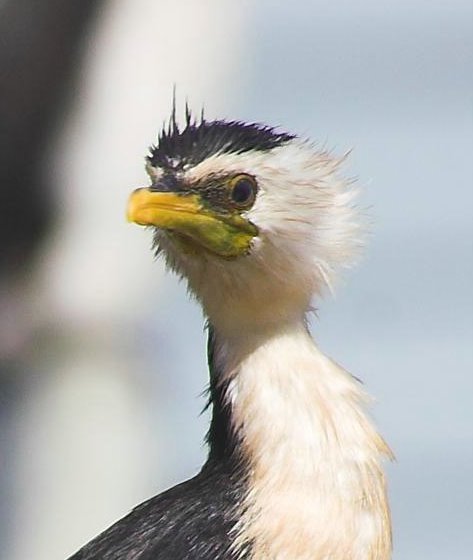 Couldn't resist posting this shot of a Little Pied Cormorant drying out, as cormorants do, after a fishing trip. Obviously used to the presence of humans, it allowed a close approach for this picture. Photographed on a local pier near Bellerive village.
Friday, January 27, 2006
Look out for...
It's that time of year when 2 species put on a show that's worth looking out for. The most obvious are the muttonbirds--Short-tailed Shearwater--often now to be seen close inshore in great wheeling flocks. The Derwent River is one of the best vantage points, and the flocks regularly reach the Tasman Bridge and beyond. The second, is the White-throated Needletail, known to most of us as plain 'swifts'--they appear to have had several name changes. Although in some parts of the state they are regularly seen--notably the West Coast, in the South East they generally appear from about now and on into Autumn. They often need some finding, flying high and barely noticeable to the naked eye. A good time to look is before a thunderstorm front, I think they are attracted by the insects borne up by the fast rising air mass. It's often worth scanning the clouds with binoculars. They are also attracted to the thermals rising from the tops of hills on warm days. Normally they're seen dashing hither and thither across the sky chasing insects, but last Summer, I saw a flock of 60 odd over Bellerive, in a loose flock and flying in a straight line. By coincidence, in flight, both species are surprisingly similar, although they rarely occupy the same habitat. It's worth looking too amongst the Needletails for the rarely seen (in Tasmania) Fork-tailed Swift. I have yet to see one here, but I keep looking!
Wednesday, January 25, 2006
Woodswallow Action.
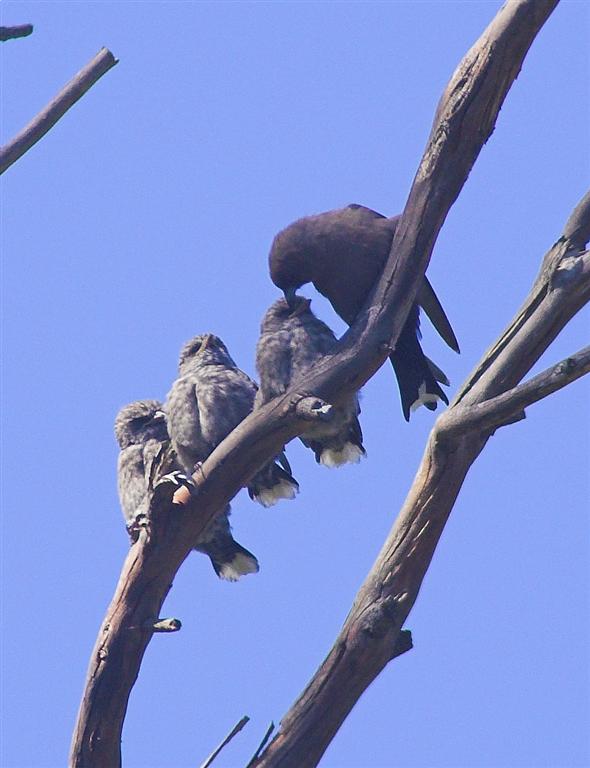
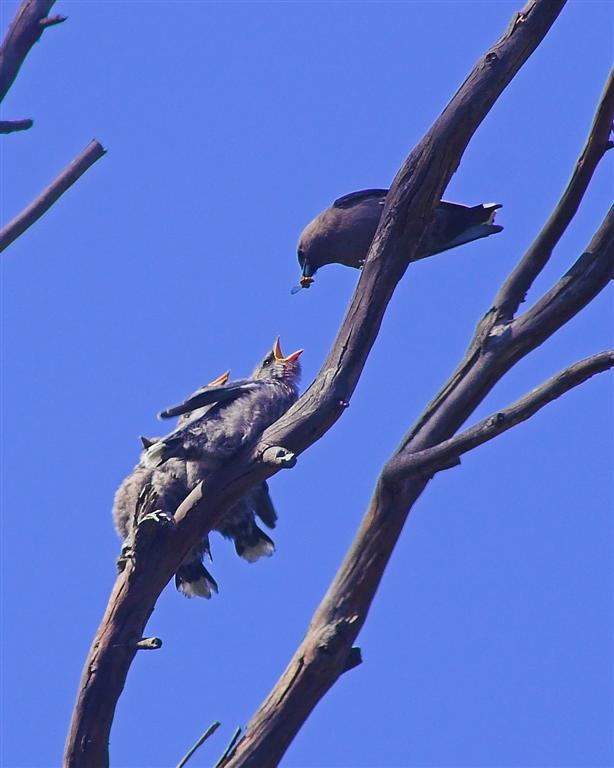
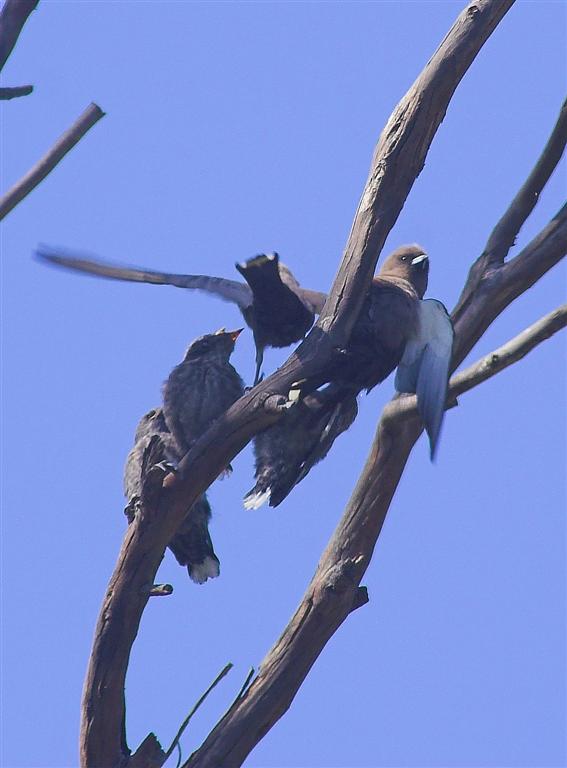
I spent sometime this morning watching a group of Dusky Woodswallows in the Peter Murell Reserve at Kingston. An obvious and common bird at the moment, these just fledged young are most probably a second clutch as I recall seeing similar sized youngsters here a couple of months ago. The fledglings spent much of there time on this dead branch about 8 metres up, preening, while keeping an eye out for their parents. The pictures show preening of young by an adult--seemed to be preening those "bits" around the head that they were unable to reach themselves. Feeding, and an adult arriving with food and dislodging both the other parent and a youngster.
Monday, January 23, 2006
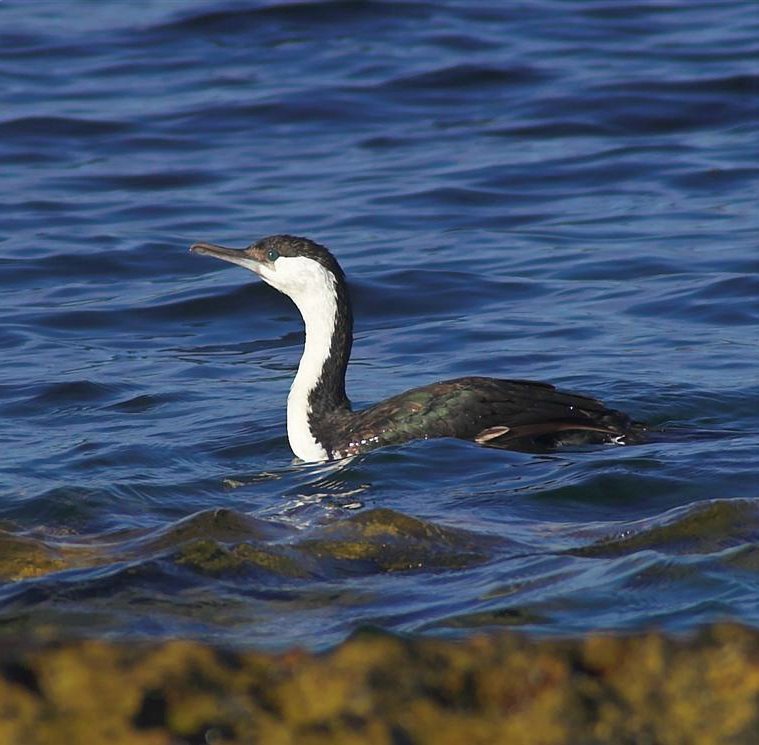
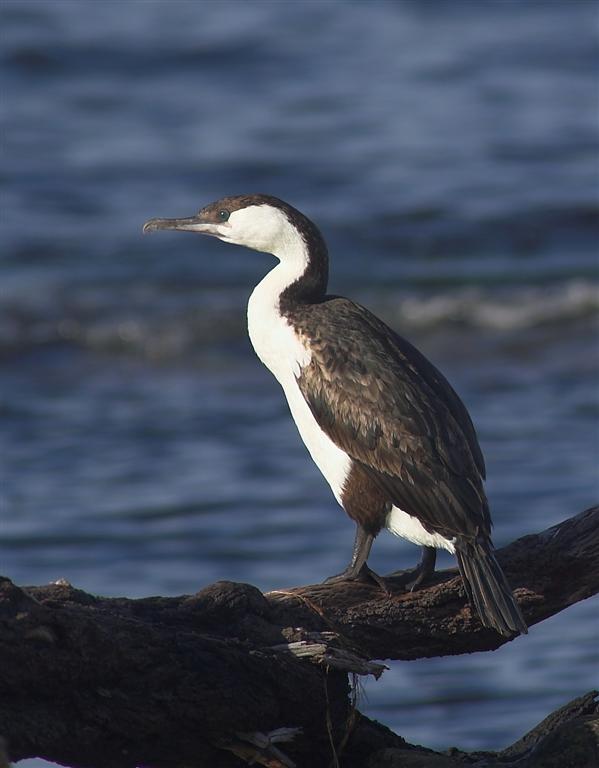
More Shags on the Rocks?
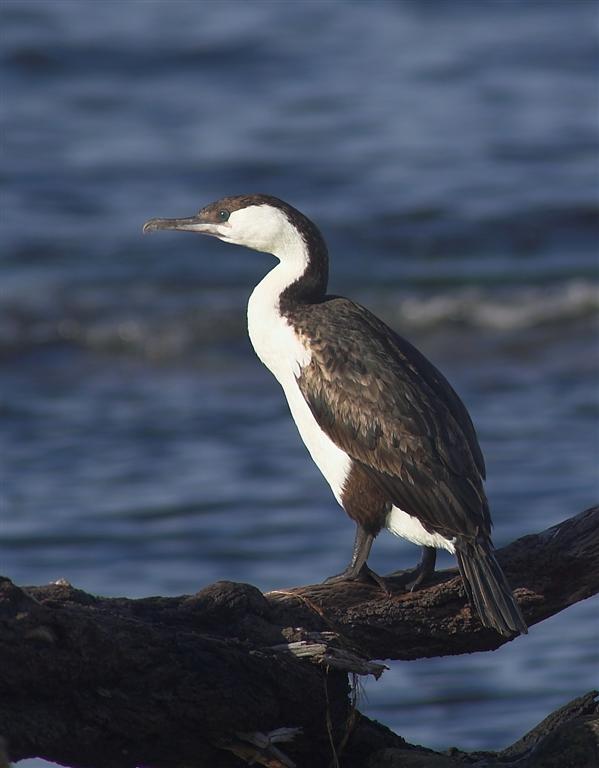
My impression in recent years is that there is an increase in the number of Black-faced Shags in the Derwent Estuary. Bill & Els ,mentioned the numbers breeding on Betsey Island (see their earlier blog:"Iron Pot & Betsey Island 2/12/05"). Certainly around the Bellerive area, the numbers roosting on rocks and piers has increased. No doubt that could be explained in part, to the recent breeding season. I feel that it may have more to do with the banning of net fishing in the upper parts of the estuary, enabled in recent years. I have witnessed amateur fishermen pulling drowned cormorants from their nets and heard tales that are nothing short of horrific if true--(well you know what fishing stories are). I understand that Little Penguins suffer a similar fate.
Tasmania, Bass Strait in particular, is arguably the stronghold of this Southern Australian endemic species, but the Derwent is one of the easiest places to see them.
The accompanying images were taken on the Bellerive 2nd Bluff in the last few days.

Tasmania, Bass Strait in particular, is arguably the stronghold of this Southern Australian endemic species, but the Derwent is one of the easiest places to see them.
The accompanying images were taken on the Bellerive 2nd Bluff in the last few days.
Saturday, January 21, 2006
Fern Tree Foray
 A few days ago I made one of my fairly rare visits to the Fern Tree Glade in the foothills of Mount Wellington. In recent years I've mainly gone there for the benefit of visiting birders, who have requested to see Scubtits, Pink Robins, Tasmanian Thornbills and Ground Thrush (I think properly called White's Thrush, although a field guide calls it Bassian Thrush). An early start on a very still day, I rated my chances of seeing all 4 fairly highly, and I was mindful of Murray Lord's comments (see "Questions Posed") about not reliably seeing Scrubtits there, a statement I agree with. I appeared to be the first arrival and climbed the steps and the first bird I saw and heard was a Scrubtit! To be honest I've never seen them that close to the entrance, but less welcome was the presence of a presumed family of Kookaburras.
As you might expect at this time of year, it's pretty dry and will no doubt get drier. My impression over the years is that the general nature of the area is gradually changing. Many trees and other vegetation falls and is cleared, slowly opening up the gully and I'm not critical of this, it is primarily maintained as a walking track. As I walked deeper into the glade, I became aware of Pink Robins calling and shortly observed my first and then a second, both either females or juveniles. Several Grey Fantails and numerous Silvereyes briefly put in an appearance, and then I heard a Brown Scrubwren. This is a species that, in the past, I've always considered to be sure to see in some numbers, but this day they were either keeping quiet or the numbers have declined. In the canopy, and in the trees towering overhead, I heard Tasmanian Thornbills, several flocks I would guess. I must confess, I only had fleeting glimpses of these thornbills, but I have no doubt that they were Tasmanian.
Only one species to go! Well to cut a long story short, I dipped out. Generally I've found them on the tracks away from the gully, and not among the Tree Ferns. It was cool enough in the reserve to create 'clouds' from expelled breath, and I started to wonder whether this was the reason for a general lack of activity--not much in the way of flying insects--apart from the mossies.
Perhaps we've all relied on this venue to 'dish up' the required species too long. There must be many sites in this general area where these species can be reliably found--any suggestions?
Successful Immigrants
Two success stories in the bird world in this state, are the Goldfinch and Greenfinch. At the moment they are among the most obvious of species in and around suburbia. While the Goldfinch was probably introduced by well meaning 'acclimatisation societies', the Greenfinch is a much more recent immigrant. Probably originating in Victoria, the first records were in 1945 at Marrawah on the far NW coast. Since then it has spread far and wide. Flocks of 100 or so can be found during the Winter months, often in coastal areas and sometimes associating with Goldfinches. Probably neither species are high on your list of important species, but they seem to have occupied a niche not exploited by native species. It may be worth considering that in much of suburbia , especially during the Summer months,if it wasn't for our introduced species, our gardens might be somewhat lacking in birds, although some of us who grow soft fruit, might sometimes prefer it that way!
(Both photos shown were taken at Bellerive and are of birds in She Oaks)

(Both photos shown were taken at Bellerive and are of birds in She Oaks)


Subscribe to:
Posts (Atom)