 John & Shirley Tongue write: We were pleasantly surpised today (Thursday) to get a reasonable shot of only our second ever Spotless Crake. It was at Gould's Lagoon, (Granton) and put on a good show for us, even appearing in the background of a couple of our shots of a very striking Purple Swamphen. The signs at Gould's Lagoon speak of Spotted Crakes there, too, though we have never 'spotted' them there, or anywhere else!
Friday, March 31, 2006
Spotless Crake Spotted
John & Shirley Tongue write: We were pleasantly surpised today (Thursday) to get a reasonable shot of only our second ever Spotless Crake. It was at Gould's Lagoon, (Granton) and put on a good show for us, even appearing in the background of a couple of our shots of a very striking Purple Swamphen. The signs at Gould's Lagoon speak of Spotted Crakes there, too, though we have never 'spotted' them there, or anywhere else!

Thursday, March 30, 2006
It Must be Autumn
 Just seen my first Crescent Honeyeater in the garden this year, marking for me, the beginning of Autumn. In fact most of those I see there are males, the image shows a female photographed a week ago in nearby woodland. If the Little Wattlebirds don't hassle them too much, no doubt I'll hear their 'egypt, egypt' call, incessantly for the next 5 or 6 months.
Wednesday, March 29, 2006
"Clinkers"
 I went birding in the middle of the day on Tuesday, something I rarely do, but it was such a great day, I couldn't resist! I was struck with the overall lack of bird activity (good reason not to go at that time), with the exception of two species which were very active--Forest Ravens and Grey Currawongs. I often hear the clink clank of the Grey Currawong, but rarely catch more than a distant view. I came upon a small group, quite probably a family, which flew off as I approached, save for this individual pictured.
It sat in the tree and called repeatedly, with no result, and seemed to get quite agitated, before it too flew off, in the opposite direction to the rest of the flock.
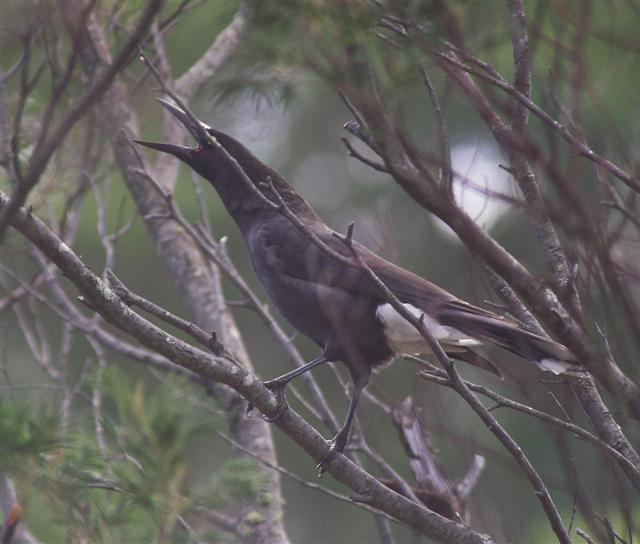 I must confess that I used to have some difficulty in differentiating the Grey, or Clinking (my preference) from the Black, mainly because one tends to see only their backs, often at some distance, as they fly off. This Currawong has kindly raised its' tail to show the diagnostic white undertail coverts. In recent Winters, they occasionally frequent the gardens in my neighbourhood, much to the consternation of the local birdlife.
Monday, March 27, 2006
Tasmania's 'Hummingbird'
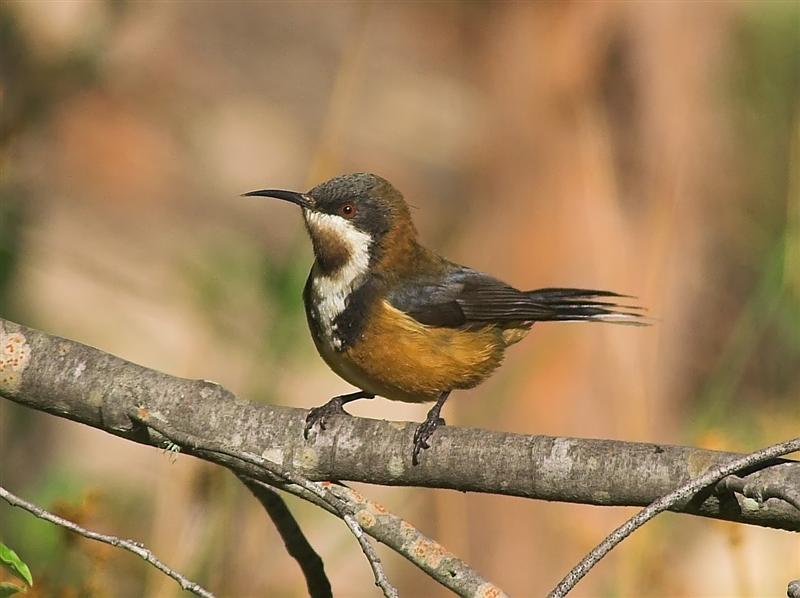 If any Tasmanian bird deserves that epithet, I'm sure it would be the Eastern Spinebill. Our smallest honeyeater, but still something like twice the length and around four times the weight of the average hummingbird, but they have certain behavioural traits in common. They seem to dash in, feed on some, often tubular flower, frequently while hovering, and they're off again--perhaps it's the high glucose diet! The Spinebill, in my experience, is something of a nomad for much of the year, and I can't think of a spot that I could go to with any certainty of seeing one. Locally they seem more numerous during the flowering of the epacris, common in open woodland and heath, and flowering during the colder months. At other times, grevilleas and small flowered fuchsia seem popular. I've yet to see more than three or four at a time, usually on some particularly favoured flowering shrub. Pictured here is a male, photographed earlier this month, possibly an immature bird as it doesn't appear to have acquired the bright red eye of an adult.
Sunday, March 26, 2006
A Young One
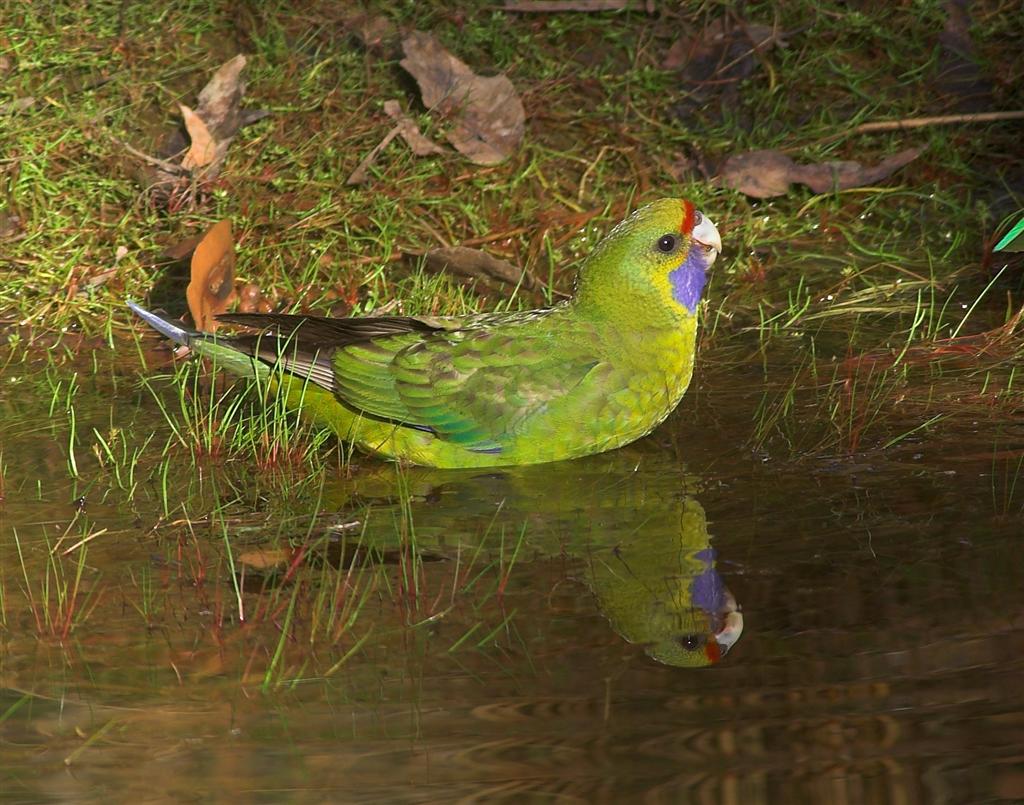 A 1st year Green Rosella enjoys a dip. These birds spend a deal of time in the water washing their plumage. I've posted this image to show the 'green' stage of this rosellas plumage. In fact, I believe at this time of year, they're still undergoing moult, which may explain the frequent batheing. I've often noticed them in streams in other parts of the state, sometimes with Bluewing Parrots. Another explanation could be that they are subject to the ravages of feather lice or similar parasites!
Saturday, March 25, 2006
Tasmania's Own 'Rosehill" Parrot
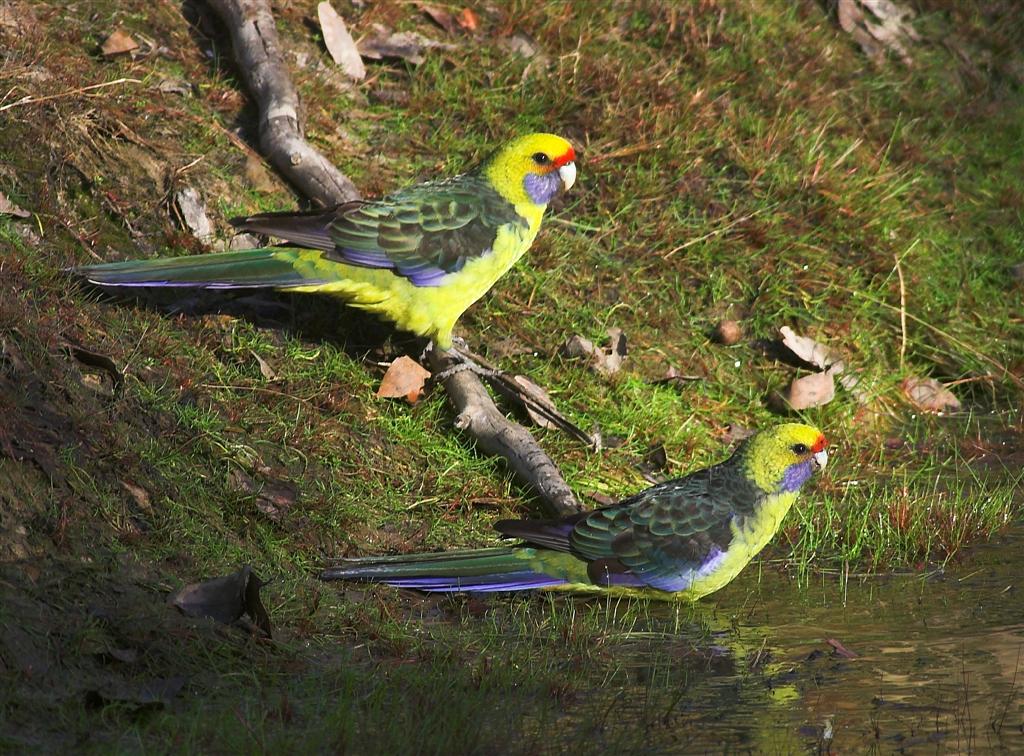 I thought the accompanying image of a pair of Green Rosellas may be of interest. I have photographed numerous Green Rosellas over Summer, either bathing or gorging on the fruit of the Native Cherry. Most of the flocks I've seen have been made up solely of the green plumaged, immature birds, which suggests that this breeding season was good, at least locally.
This image, by chance, shows both male (upper) and female adult birds in juxtaposition, and enables comparisons of plumage etc.. I was quite struck by the differences, both in 'bulk' and in bill size. I guess we don't often get the chance to see them like this, and usually just make a mental note, 'Green Rosellas', as they noisily disappear from view!
Friday, March 24, 2006
Albatross!
 John & Shirley Tongue write: There is great excitement in our household today! (Thursday). Never having had much to do with the sea, neither of us had ever seen any of the truly pelagic birds. We've been looking to get on one of the pelagic trips, but they're mostly on Sundays, and being a church minister, that doesn't really work for me!!
Anyway, today we walked from Fortescue Bay to Cape Huay, on the Tasman Peninsula. The whole area had recently been burnt--last year I think, so bush birds were pretty unrewarding, except for three Flame Robins. However, when we got to the Cape, there was a "pod" (flock? mob?) of seals feeding off Mitre Rock, accompanied by assorted Gannets, Cormorants, Gulls and Terns. Also, to our excitement, we were able to identify a number (perhaps 15-20) Shy Albatross among them. These are supposed to be very common, especially around the Hippolytes, but they were the first Albatross-of any variety-either of us had ever seen. Certainly not a GOOD look, at them, but identifiable, and very exciting for both of us, just the same.
The photo shows Mitre Rock and the Candlestick in the foreground, and the Hippolyte Rock beyond. At this stage, the seals and the birds had gone behind Mitre rock.
Wednesday, March 22, 2006
My Reward
 At his request, I took Denis Abbott to see the "much vaunted" waterhole in the Meehan Range today. With the cooler weather, there are fewer birds visiting, but despite that, some 12 species, perhaps more, partook of the waters. Denis wanted to try out his new digital camera and thought this might be a good spot. I suspect he found there was a fairly steep learning curve! But there are few short cuts and practice and patience have their own reward. I feel my reward was getting the chance to take the accompanying pix of the aptly named Beautiful Firetail. I had seen them coming down to the water on previous visits, but they are generally fairly secretive in their approach. This year I've only seen
 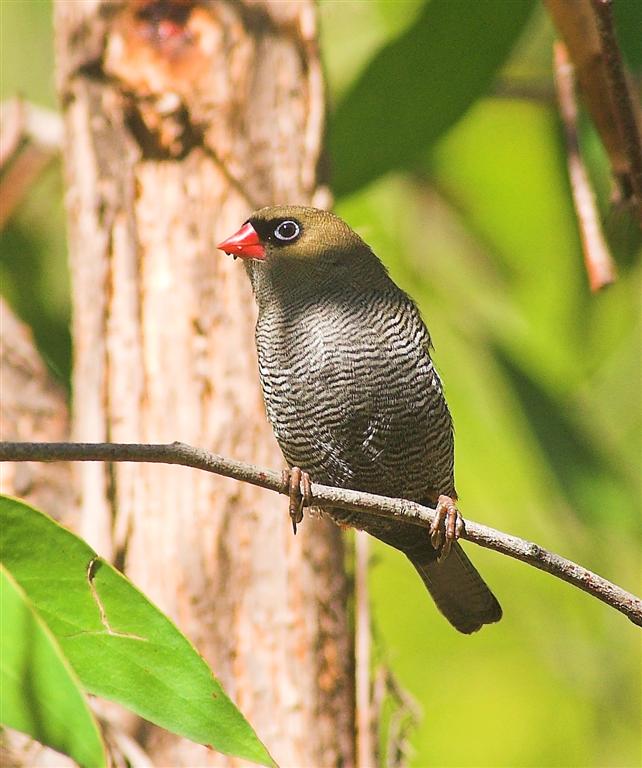 odd birds and not the usual family groups. The Meehan Range appears normally to hold good numbers of Firetails.
Tuesday, March 21, 2006
Measure of Success
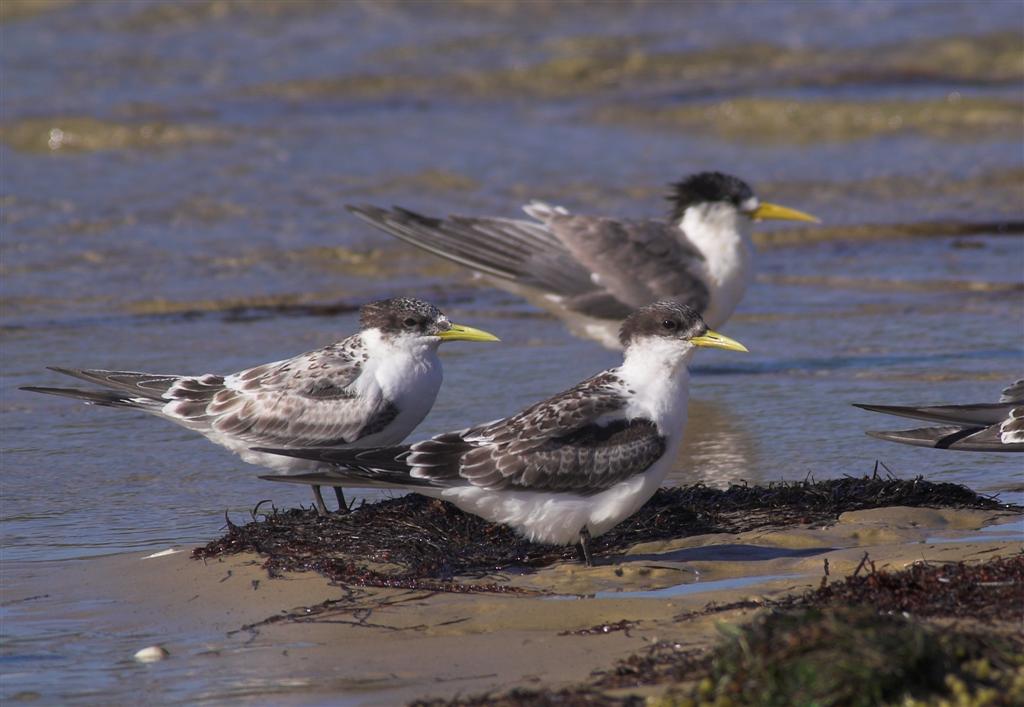
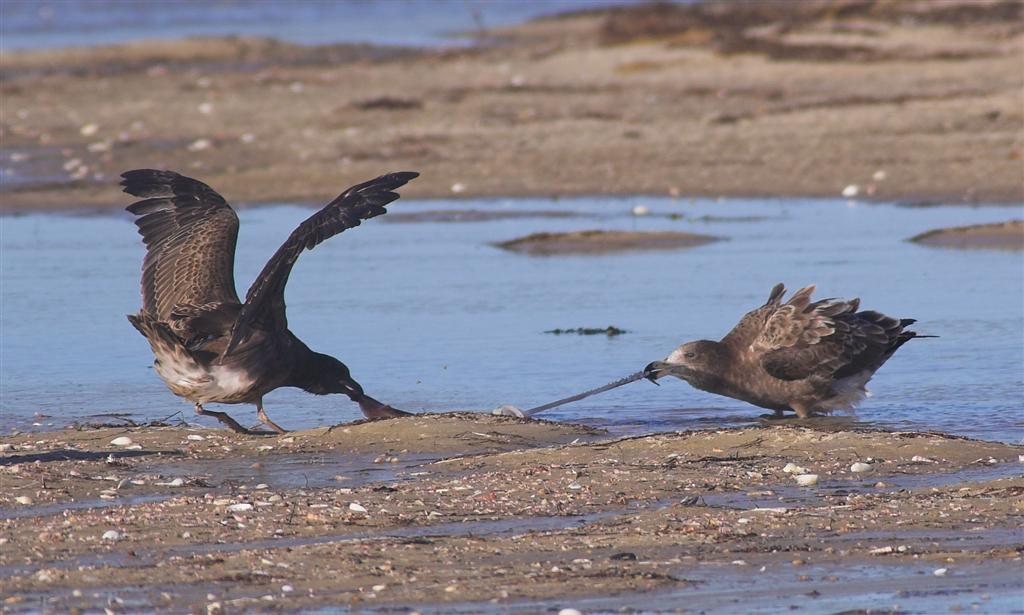 A measure of a successful breeding season is probably most easily seen in the number of young birds produced. The accompanying images are of some of this years young Pacific Gulls, Kelp Gulls and Crested Terns seen recently on Marion Bay Spit. The gulls are most likely the progeny of birds nesting on Visscher Island, some few kilometres off shore. I'm not sure where the Crested Terns nest, but they too would have bred on offshore islands. Many of the young terns are largely still with their parents and although they are quite capable of fishing for themselves, they also s
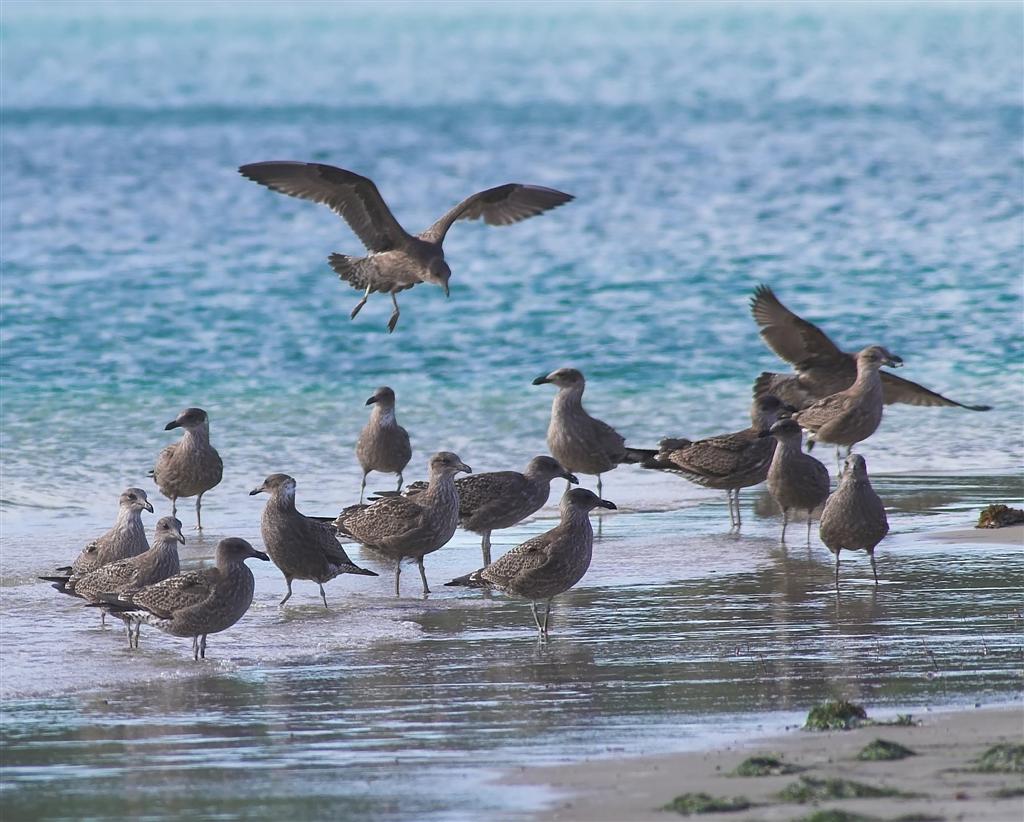 eem quite able to "cadge" fish off passing adults. In contrast, the gulls are now left to their own devices and gather in species specific groups.
I must say that the continued increase in the number of Kelp Gulls causes me some concern and needs investigation, as I believe they constitute a threat to some of the areas in Southern Tasmania set aside as reserves for waders, both indigenous and migratory. They are breeding in sensitive areas such as Orielton Lagoon and the South Arm Neck, and their presence in coastal areas has an inhibiting affect on the use of those areas by waders. In the case of Orielton Lagoon, the gulls have occupied something like 40% of the land area at the Northern end, and this is a no-go area for
waders
Monday, March 20, 2006
Aberrant Oystercatchers
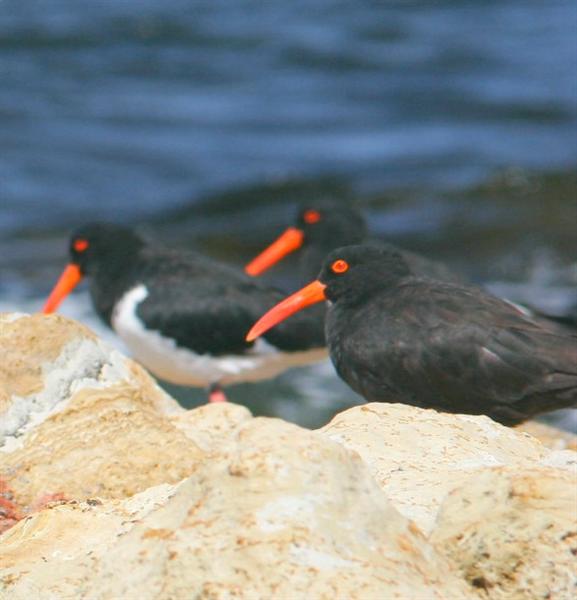

Felix Wilson sent in these 2 pix of aberrant Sooty Oystercatchers. He photographed them a couple of weeks ago at South Arm. If you click on and enlarge them you will see one has a curved bill and the other has a number of white feathers among the otherwise black plumage. He poses the questions, are the white feathers a result of interbreeding of Pied with a Sooty or just a genetic mutation? And what would cause the downcurving as pictured? He adds that Priscilla Park has a photo. of an oddly plumaged Pied Oystercatcher. Has anyone else seen any to add to the list?
Sunday, March 19, 2006
'Aggro' Heron
It's not only Wedgetails that can act aggressively to one another. While down at Marion Bay recently, I became aware of the sound of a heron calling "aggressively"--if that makes sense! Shortly after, I found the source, a couple of White-faced Herons playing chase. The chaser seemed pretty agitated, but I've no idea what caused it. They were surprisingly agile for 2 slow flying birds, not usually known for their aerial skills. I lost interest as they disappeared into the distance and I swapped my interest to a flock of Bartails. A few minutes later, the heron pictured here, landed very close by and stayed long enough for me to take several shots. I was surprised by its' landing so close, but wondered later, whether it was the bird being chased and I was some sort of safe haven.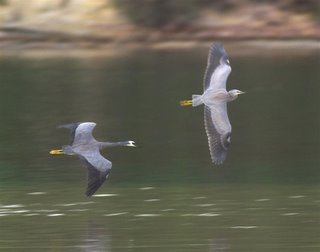
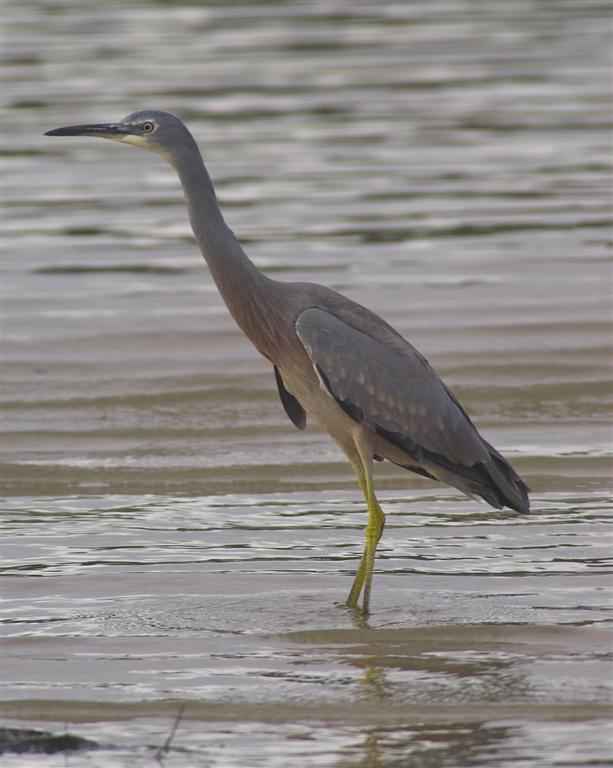 recently, I became aware of the sound of a heron calling "aggressively"--if that makes sense! Shortly after, I found the source, a couple of White-faced Herons playing chase. The chaser seemed pretty agitated, but I've no idea what caused it. They were surprisingly agile for 2 slow flying birds, not usually known for their aerial skills. I lost interest as they disappeared into the distance and I swapped my interest to a flock of Bartails. A few minutes later, the heron pictured here, landed very close by and stayed long enough for me to take several shots. I was surprised by its' landing so close, but wondered later, whether it was the bird being chased and I was some sort of safe haven.
Subscribe to:
Posts (Atom)