A few days ago, during a break in the "indifferent" weather, I set forth to visit some of the local traps. The first few seemed ominously quiet, and I finally settled on the Mortimer Bay reseve at Sandford, a favourite of mine. I can't say it was jumping with birds, but the New Holland, Crescent, and Yellow-throated Honeyeaters, Brown Thornbills, Spotted Pardalotes and the Superb Fairywrens at least kept me interested. I stopped briefly to photograph a thornbill. It had caught my attention with an unfamiliar call, perhaps it was seeking a mate, it was strident, but not the usual territorial call. I could hear a nearby Dusky Robin calling, but failed to see it. Several Grey Butcherbirds called. They have taken up residence in the coastal strip of pines and from previous experience, they make the local birds 'jumpy'.
A few pairs of Grey Fantails were evident, brushing the acacia bushes with their wings to dislodge insects and then swooping, with great agility, to catch them in mid-air. Pairs of Scarlet Robins were active along the tracks, making forays from a convenient perch to catch grounded insects, but even they were hard to approach on this occasion. Of woodland species, I must have photographed 'scarlets' more often than any other, especially the "showy" males.
I was about to call it quits, when I heard the unmistakable 'descending trill' of a Fan-tailed Cuckoo, close by, high among the tall pines. As I neared the pines, it called from the acacia scrub alongside of the track and as I neared them, it called from the lightly wooded area a further hundred metres away. It was mobile!
At this point, for some reason, I became determined, perhaps obsessed, to see it, photography was in any case unlikely. It had thrown down the gauntlet (in my mind at least). Fan-tailed Cuckoos are a common enough summer visitor to this state, and a few are assumed to overwinter., mostly in coastal areas. So is this an early arrival, or just failed to migrate? Most of their 'host' species, thornbills and fairywrens, are early breeders, so early arrival would appear to benefit this cuckoo.
I then had a stroke of luck, it flew across the track only metres away and called from the nearby scrub. I had at least seen it. I closed on the scrub, it flew a short distance, and appeared to alight in a young eucalypt. I stood for several minutes peering through my binoculars, hoping for a better view and at last found it. It was facing away and surprisingly cryptic for a fairly large bird (26cm.), but appeared to well aware of me. It called and an answering call came from some distance away. Now I understood why I had thought it so mobile--presumably a pair. With careful approach I even managed to get close enough for a 'shot' or two, as you can see.
I left soon afterwards, feeling, I must admit, a little smug!
Tasmania,island state of Australia. Alan Fletcher's occasional blog about the enjoyment of birding in Tasmania.If your interest is images, visit my pbase site (see "links"). All images are copyright owned by their authors. If you wish to use any, please ask E-mail: tassiebirds@iinet.net.au
Sunday, June 10, 2012
Friday, June 01, 2012
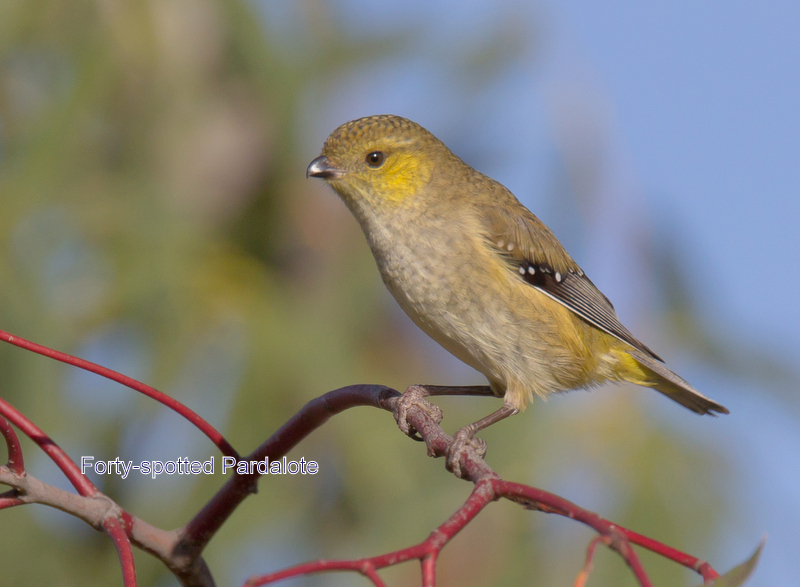
Pardalotes........40 Spots or Not ?
I had taken my son and granddaughter, Jade, to Fossil Cove, near Blackman's Bay. Jade has a new found interest in fossils which needs to be encouraged, and this site was one that I thought worthy of visiting, which it proved to be. The downside was the 'climb' back up, made only slightly more bearable by the variety of birds seen--a spot for further exploration.A short drive and we stopped to explore some roadside vegetation that appeared to have possibilities. Almost immediately we noticed a pair of Spotted Pardalotes feeding in the low hanging branches of a peppermint that seemed a good photo opp., which it proved to be. I took a few shots of the female (at top), and reviewed the results on the camera's LCD screen, put the camera back up to my eye, refocused, and did a double take! In place of the 'spotted' I now had a 'Fortyspot'--a couple of shots and it was gone.
We stood around looking for this bird and found that we actually had 2 pairs, and they seemed much more interested in chasing each other than in our presence, so I was able to take several more shots. If you're interested they can be found on my pbase site via the link at right.
When I have been out and about birding, on many occasions I have stopped to talk to passers-by about what I'm doing, ( I have in part, found the need to explain my potentially suspicious looking gear and dress). One of the more popular bird topics raised has been about 'fortyspots', they're one of the birds that people seem to have heard of, they are after all, an iconic Tasmanian endemic species and listed as "endangered". They frequently top the list of 'must see' birds for visiting birders. On a number of occasions, the 'passer-by' volunteers that they have seen the fortyspots in their garden, or in a nearby park. Being the sceptic that I am, I usually pass over the subject of the improbability of their sighting, not wishing to offend them, but some are not easily put off. Sometime I may press them for more information, especially if they live somewhere near a known breeding site. Forty-spotted Pardalotes do roam in the cooler months, but you're more likely to see the common, and much more 'flamboyantly' plumaged, Spotted Pardalote, or during the Summer, the widespread Striated Pardalote, which in any case lacks 'spots'. Undoubtedly the best place to see the fortyspots is Bruny Island, in the lightly timbered areas almost always among stands of White Gum Eucalyptus viminalis. The Peter Murrell Reserve at Kingston, which for many years was the best spot near Hobart, has become somewhat unreliable in recent times, but I understand that a few pairs still 'hang on' there.Friday, May 18, 2012
Patience Rewarded.....Pacific Gull
Interactions between birds are always interesting, and it's easy to second guess the outcome, as I did on this occasion. I had briefly stopped at Lauderdale Canal on the way home from birding. There is almost always something to watch there, much of it commonplace, but I caught sight of a Pacific Gull washing and thought it worthy of recording it photographically.
Around many of the bays and inlets, pairs of Pacific Gulls are encountered at this time of year. They often set up exclusive territories, becoming quite aggressive to others of their species who venture too near. One such pair calls the Lauderdale Canal home. They spend much of their time loafing about, and although they are quite obviously a 'pair', they are seldom seen together, even when food is around. Because the canal perimeter is a popular walk, they are used to the close proximity of humans, and the bird pictured allowed close approach. I spent several minutes photographing this gull, when I noted an immature Black-faced Cormorant diving for fish as it passed by. These cormorants are frequent visitors to the canal during the Winter months, feeding on the schools of small fish 'trapped' in the canal as the tide falls. I should mention here that although called a "canal" it is only open at one end, only ever having been a true canal very briefly, since the 19th century when it was constructed.
After one dive, the Black-faced surfaced carrying a decent size fish, which I incorrectly surmised was a flounder. The Pacific Gull had noticed this too and stopped washing and slowly swam towards the cormorant. Perhaps rather over eagerly, I suspected that I might get shots of a free for all, and watched expectantly. The Pacific swam to a metre or so away and just watched and waited. The cormorant was having difficulty in turning the fish round--they swallow fish head first--and several times the fish appeared to escape but was quickly recaptured. That was not all for despite these birds capability to swallow quite large fish, this was patently too big for it to swallow, but it persisted. The shot of the cormorant was its' last try. It gave up. The Pacific Gull swam over, retrieved the, by now, dead fish and carried it to the far bank of the canal. It was at this point that I realised that the fish was a Leatherjacket, complete with a large vertical dorsal spine (visible in the lower shot). No wonder the cormorant couldn't swallow this fish. Although, as the name 'leatherjacket' implies, this fish has a tough skin, the Pacific Gull had no difficulty in tearing the fish open. Pacifics have, arguably, the bulkiest bill of any gull worldwide. It was an interesting encounter, but I have to confess I did feel a little disappointed that it had turned out so meekly!Monday, April 02, 2012
French Visitor from the LPO
I'm often asked to guide visiting birders around some of the local birding sites and almost invariably decline, but I was recently somehow cajoled into doing so. The recipient of my "largesse" was Philippe de Grissac, who was staying in Hobart with his partner, Nichole, as the guest of Dr Ian and Ann Crawford, of West Hobart. The Crawford's had befriended members of the French Antarctic organisation after a fatal helicopter crash in the Antarctic. The French operate the resupply vessel L'Astrolabe out of Hobart.Philippe is the vice-president of the French bird conservation organisation LPO--La Liege Francaise pour la Protection des Oiseaux, the French equivalent of the British RSPB. I must confess that I'd never heard of the organisation, but it has just celebrated its' 100th birthday! My stereotypical view of the French is that they're more likely to eat the wildlife than conserve it. My lack of knowledge is perhaps all the more surprising, since I lived near the English coast not far from the Channel ports and visited France on the early "no passport" trips regularly. However, I do remember that these trips had more to do with duty free than any interest in French cultural pursuits. I also remember a lack of locals on the street, and now realise that our boorish behaviour may have been the cause--I don't recall ever seeing any birds there, not sure what that tells me!
Our first outing, to the Waterworks Reserve at Dynnyrne, wasn't exactly auspicious as it drizzled constantly, but we soldiered on, ticking off at least a few of our endemics, before retiring to a local coffee house.Philippe and Nichole then toured the state and our second excursion was a week or so later, also to the Waterworks at Dynnyrne--I've found this to be one of the best sites to see a cross section of Tassie's birds. This visit included other members of his family (their relationship I wasn't sure of, and was afraid to ask--well they are French!). I do know it included his daughter, Sophie (pictured with binoculars at the ready), an ornithologist in her own right, and had just returned from the Antarctic--the reason for Philippe's visit. Sophie has recently co-authored a paper in the prestigious publication, "Science" entitled "Changes in Wind Pattern alter Albatross Distribution and Life-history Traits"--an interesting read. Due to a language "issue", I inadvertently led Philippe to believe I too had written a paper for "Science", and it became too difficult to put that to right. If you read this Phillipe, I have co-authored several papers, but definitely none have reached such exalted publications!
At the Waterworks we managed a good haul of local birds, including close views of a pair of Pink Robins. A pleasure meeting Philippe and family, I only wish I had paid more attention during my now distant French lessons.
Saturday, February 25, 2012
Shag Bay Bluewings & more
The lightly wooded area around the entrance soon produced flocks of 'tanging" Silvereyes, family groups of Black-headed Honeyeaters in the outer branches of the eucalypts, the strident calls of Yellow-throated Honeyeaters, and the less welcome sounds of a family of 5 Grey Currawong tearing bark off trees in their search for insects. As the trees thinned out and still within cooee of the entrance, I flushed a group of 5 or so Blue-wing Parrots, that I had failed to see on the track. Elated in finding them so soon, I followed them up the hillside, closed on one, but again failed to see the rest only a few metres away and again flushed them. Happy that I'd seen them I rejoined the track and walked on.
On leaving the light woodland, the track diverges from the coast and crosses an open expanse of, at present dry, grassland, with the occasional eucalypt, including dead ones, thickets of acacia, and along the coastline, many she-oaks. An immature Yellow Wattlebird feeding in a distant tree soon caught my attention and as I stopped to watch, a covey of 5 Brown Quail burst out of the nearby grass, I followed them with my bin's until they disappeared back into the grass. A solitary Australasian Pipit hopped along the mown areas adjacent to the track and for a brief moment I thought I might have a photo opp., but no, it was off and away.
I decided to try the coastal strip and left the track in the hope of finding the aforementioned firetails and almost immediately spotted a lone bluewing, sunning itself in the warmth of the early sun, atop a dead branch. As I neared it, I found a group, usually referred to as a cluster, of young Dusky Woodswallows, also sunning and preening themselves while they waited to be fed by their hard worked parents. This clustering is a well known phenomenon, although the reason for it is debated, and I have seen and photographed this on many occasions. This group of only 6 birds, is small and I have seen groups of 18 youngsters huddled together. I moved on, closing the sunning bluewing, taking a few distant shots on the way. A few steps more and I flushed another covey of Brown Quail, only 3 this time, but it also flushed what I had assumed to be a lone bluewing, revealing that there were in fact 7. I watched them alight in a nearby tree and occasionally drop into the grass to feed, but they were understandably wary and I enjoyed just watching them go about their business.
Moving into the coastal strip above Shag Bay, I observed a Little Pied Cormorant fishing in the bay below and above it, in a tall eucalypt, a watchful White-breastd Sea Eagle.Once in among the scrub, while watching passing pairs of feeding Spotted Pardalote, I heard the mournful double 'contact' notes of a Dusky Robin. I followed the sound and found a family group of duskies. They gave me a brief chance at photographing them before moving on. Like many bush birds at the moment, they weren't at their best, being in various stages of moult, but worthy of a shot or two nonetheless.
Returning briskly along the track, I occasionally stopped to watch bluewings, some passing overhead "zitting", others atop dead trees, ever watchful. Something "stirred" the bluewings at one stage, and I counted a total of 22 birds rapidly wheeling in a single flock, quite a sight. A single Black-faced Cuckoo-shrike made low forays for insects close to the track and an immature Grey Butcherbird caused some panic to another family of Dusky Robins, and they took refuge in an acacia thicket. I walked over to the thicket, spotting the robins within, but was surprised to see that 3 bluewings were roosting inside. I left them in peace. Nearing the end of the track, I noticed the group of parrots that I'd seen early into my walk were back feeding trackside. I suspect that seed, their main food source, is blown or 'gravitates' down the hillside and collects on the track at this spot--sure beats 'trolling' among the grass! I slowly closed on them taking a few shots as I did, before they spotted me and flushed into the trackside shrubbery. In the last few metres, I added Green Rosella, New Holland Honeyeater, a stray Crescent Honeyeater and Brown Thornbill to the morning's list. Alas no firetails, but a pleasant morning's birding, and a note to revisit soon.Sunday, February 05, 2012
Cooperation.......Little Black Cormorant
As I scanned the length of the waterway, I noted a gathering of Silver Gulls near a drain about half way along, and on closer inspection I could make out a number of diving cormorants. These turned out to be a group of around 20 Little Black Cormorants, and not the usual Black-faced and Little Pied. Although Little Blacks are by no means uncommon, they are the least likely to be encountered, at least in the south east. A cormorant roost at Gould's Lagoon at Granton, is the best local spot to see them, where they share the roost with Great and Little Pieds, or in Derwent Marshes nearby. Where they are seen they are usually in flocks numbering in the tens of birds, but occasionally in the hundreds.
Although I had my trusty camera with me (no I don't take it bed), the conditions were marginal for photographing black birds in 'dark' water, and I was content to just watch. Little Blacks work cooperatively, 'herding' fish together or, as in this case, into shallow water, before rather frenetically diving into the school to catch their 'share'. The gulls hung around hoping to get the leftovers, and a White-faced Heron raced back and forth along the bank in excitement, but only managing to seize an occasional fish and was in turn set about by the Silver Gulls, who, despite their efforts went largely unrewarded. It was fascinating to observe the interaction between the species. An occasional Crested Tern put in an appearance, and I noticed a Pacific Gull with a small fish, which I suspect had been pirated from a cormorant.So where did the photographs come from? Well I returned the following day in the hope they would return, and initially I was disappointed and went elsewhere to birdwatch. Returning a few hours later I found them drying out on the canal bank, possibly having fished in one of the nearby bays. Watching them for some 20 minutes, they must have noticed fish surfacing because they suddenly half flew, half fluttered 50 metres down the waterway and started fishing. They bunched together, one or more with head submerged, swimming rapidly. If one dived the others would quickly follow. Trying to get decent shots during this operation proved elusive as they frequently changed direction, dived or flew several metres and recommenced their efforts. It was all over in minutes and they emerged to dry out again further down the canal. I did manage the image at centre, with the bird apparently "washing". Most cormorants do this before roosting, especially the Black-faced. I had previously concluded that it was indeed "washing", but I'm pretty sure that I'm wrong. I think they are probably fluffing their feathers to get the air back in them. This would improve body insulation and aid drying. I would be pleased to get other people's thoughts on this.
Monday, December 19, 2011
Season's Greetings
Have a happy and safe Christmas and New Year
I recently photographed this Australasian Grebe on a small farm dam. These grebes have made a slow and sustained increase in numbers over the last 30 or so years, thanks largely to the increase in water storages on many farms in the east and south-east of Tasmania. Unlike their near relatives, the Hoary-headed Grebe, which are usually found on large bodies of water and in flocks sometimes numbering in the hundreds, this grebe is more likely to be met with in pairs or small groups on small water storages--the largest group I've seen in Tasmania totalled only 5.
Sunday, December 18, 2011
Victorian Visitor......Pied Oystercatcher
I stopped off briefly at Lauderdale Spit recently en route to Pipeclay Lagoon. It's become almost a ritual and I rarely spend more than a few minutes scanning the waders, gulls and terns from a 'respectful' distance. I noted the Pied Oystercatcher roost still consisted of 200 or more birds, a seemingly large number during the breeding season. As I passed the resident pair near the highway, I could see they were becoming agitated by a third bird nearby. I stopped to watch and as the 'interloper' closed on them, one of the pair proceeded to 'dive-bomb' it. It ran off through the shallow water, and as it did I noticed it appeared to be banded.
This wasn't unusual as many Pied Oystercatchers have been colour-banded in southern Tasmania over the years, and subsequent sightings have delivered a large amount of useful information.. I often photograph them for later identification if I can do that without unduly disturbing the roosts. I walked out into the water and slowly moved the 'intruder' onto the beach a few metres away. As you can see from the accompanying image, the oystercatcher didn't sport colour bands, but a yellow 'flag' with "8D" on it. From the flagging protocols, this bird was so marked at Corner Inlet in Victoria, around 470kms away. I'm still waiting for additional information as to when it was originally caught. From local banding efforts it appears that few of 'our' oystercatchers stray outside of the Derwent and Pittwater areas, so one wonders what drives a few to travel hundreds of kilometres.
This Victorian bird was showing interest in one of the resident pair I mentioned earlier, and one could fantasise that the journey was as a result of unrequited love. But I'm sure I'll be taken to task for even jokingly suggesting it!!
Finally received the banding information on this bird. Originally banded at Barry Beach, Corner Inlet, Victoria on 13 August 2006, aged 4. Now 10 years old.
This wasn't unusual as many Pied Oystercatchers have been colour-banded in southern Tasmania over the years, and subsequent sightings have delivered a large amount of useful information.. I often photograph them for later identification if I can do that without unduly disturbing the roosts. I walked out into the water and slowly moved the 'intruder' onto the beach a few metres away. As you can see from the accompanying image, the oystercatcher didn't sport colour bands, but a yellow 'flag' with "8D" on it. From the flagging protocols, this bird was so marked at Corner Inlet in Victoria, around 470kms away. I'm still waiting for additional information as to when it was originally caught. From local banding efforts it appears that few of 'our' oystercatchers stray outside of the Derwent and Pittwater areas, so one wonders what drives a few to travel hundreds of kilometres.
This Victorian bird was showing interest in one of the resident pair I mentioned earlier, and one could fantasise that the journey was as a result of unrequited love. But I'm sure I'll be taken to task for even jokingly suggesting it!!
Finally received the banding information on this bird. Originally banded at Barry Beach, Corner Inlet, Victoria on 13 August 2006, aged 4. Now 10 years old.
Sunday, November 27, 2011
The Fence Sitters
So my recent outings have been limited to birding from my vehicle, with occasional forays close by. I guess the good news is that a vehicle makes a great hide, and it's amazing how trusting birds are to their approach. So the accompanying shots were taken from my vehicle around the perimeter of the lagoon. All of the birds were at some part of their breeding cycle.
The Australasian Pipit, found Australia-wide, was carrying food, in this instance a large spider, to a nearby nest among the tussocks, stopping off atop the fence post to survey the area for possible threats. I've rarely photographed them, although quite common in many open areas of the state. They sometimes occur in close proximity to the more commonly found Eurasian Skylark, a species introduced in the mid 19th century. These 2 species are very similar in appearance, and can present an ID challenge as you flush them from grasslands. The pipits form small flocks in winter, and live a nomadic life. One winter's morning, in a gale, a flock took refuge in my and surrounding gardens, very much in suburbia. Not exactly pipit habitat.
The White-fronted Chat, another nomad, was among several pairs feeding nestlings, again using the fence as a vantage point. They appear to breed throughout the spring and well into summer, appearing suddenly in an area, breeding, and just as quickly moving on. Usually found in family groups, they flock in the colder months, forming substantial flocks, often seen roaming the open countryside.
Lastly, and size-wise, the least, I photographed a pair of Striated Pardalote nest building, also using the fence as a vantage point. In the open country around Pipeclay Lagoon, they nest in holes in the ground or in sandy banks, but in wooded areas, they usually choose holes in trees, sometimes several in the same tree. I spotted this pair carrying long lengths of dry grass to their nearby nest hole. Of the 3 mentioned, they are the only true migrants, moving to the Mainland in winter, although a few may remain .Of course these 3 species are by no means the only 'fence sitters', but I'm grateful for their cooperation!
Wednesday, October 19, 2011
Always a Challenge....Pink Robin
One of my favourite birds is the Pink Robin, but they are often elusive, live in dense forest, and are mainly dark in colour and photographing them is often a challenge. I've found that spring is the best time to attempt photography, usually when the male is "announcing" his territorial rights. My philosophy on photographing this species is to visit various local known sites and hope. Hope for a "collision" of events--a cooperative bird, the right situation and the right light. That's not too much to hope for, is it! The other option is to wait for winter when these robins often frequent the edges of their usual wet forest habitat.So during early spring I did the rounds of local sites, such as the Snug Falls reserve, Myrtle Forest at Collinsvale, Truganini Reserve at Taroona, and the Wielangta Forest. I found Pink Robins at all sites except the Truganini Reserve. At this reserve, much of the 'usual' site has been cleared, possibly to clear fallen trees or invasive weeds. The goo
d news is that this area seems to have been taken over by Eastern Spinebill (several pairs) and Dusky Robins. I also found a pair of Beautiful Firetail nest building close to the track. But it was only at the Wielangta Forest that the "collision" occurred.
I've made a few trips to the Wielangta Forest this spring, few have produced much in the way of bird images, but it's a good venue for wet forest and rainforest species if you're prepared to put in the effort. The road is now open again, but not in great nick, and care is especially needed around the new bridge. The walking tracks are generally overgrown and have numerous fallen trees across them both large and small, making a walk more like a steeple chase. But from personal experience, there's no lack of leeches.
The visit that I finally managed some shots on was about a month ago and as often happens, I wasn't expecting it. I had only walked a few hundred metres from the road, when I heard an Olive Whistler calling, and stopped to find it. This was shortly followed by first a Bassian Thrush, then a Flame Robin calling, both from nearby dense bush. I endeavoured to locate them, but failed on all counts. A Tasmanian Thornbill and a Tasmanian Scrubwren scolded me as I pushed deeper into the scrub, arriving at a small clearing surrounded by dead or dying shrubs largely covered in lichens. I stood and surveyed the area, hoping to at least find the still calling Olive Whistler. I knew from previous visits that this was a likely spot for the whistler. A movement to my right caught my eye and a Pink Robin appeared. I stood completely still to allow a hopefully close approach. He called, flew to another branch and called again. There was dappled light passing through the forest canopy, and several potential perches around the clearing, and despite the low light level, I began to get quite excited at the possibilities. However this was tempered somewhat by previous attempts which didn't exactly measure up to my expectations.
As you can see by the accompanying images, I did manage to get some useable images, but as
always I was left with the feeling "maybe next time". [I could have used flash, but that would have"killed" the ambience, and affect the birds' behaviour.] Over the next 40 minutes I stood, watched, and occasionally photographed this robin as he went about his business. Mostly he took food from among the leaf litter and moss covered ground, pouncing on it from a perch, although I couldn't identify exactly what his prey was. On a number of occasions he came within a metre or so of me, looking, I thought, rather accusingly at me, but otherwise seemed unfazed by my presence. At close quarters, it's size becomes very apparent--it's small (c.12cms), as does the sheer beauty of the pink breast contrasting with the sooty colour of the head and body--so hard to adequately capture in photographs. The female put in a brief appearance, as did several Tasmanian Thornbills, gleaning insects from beneath the leaves of various shrubs. Eventually the wind rose and scudding clouds appeared followed by light rain. Time to leave. I hoped that I had not intruded in this birds' life in vain, but at the very least I had been 'privileged' to spend time watching this sometimes hard to find bird.
Thursday, September 15, 2011
Wander Lust..... Wandering Whistling-Duck
A report on Birdline Tasmania at the weekend, caught my eye as much from the observers' comments as from the content. Ian Lundy reported seeing 3 ducks at Lake Dulverton, that he described in detail, believing that the birds in question were Wandering Whistling-Duck. He was not able to get any shots with his phone (photographs have become almost mandatory for rare bird sightings). He concluded by saying: "this bird is not found anywhere near here but it is what I saw--please tell me I'm not going crazy". This species breeds in the tropical north of Australia and is uncommon to rare further south, and as far as I'm aware, has not been recorded in Tasmania before, so I guess Ian's comments are not unreasonable.Being old and sceptical, I awaited developments and they were not long in coming. Paul Brooks sent me an email saying that he had subsequently seen them, confirmed their identity, and thought that it might be possible to photograph them. I have to say I wasn't particularly enthused, my twitching days are largely behind me, but as Lake Dulverton is almost always worth a visit I gave a lukewarm reply.
Consulting the weather forecast for the rest of the week suggested a visit might be better sooner than later, so on Wednesday morning I set forth. It's an hours drive from Hobart an
d although I set off in high hopes, as I approached Oatlands (where the lake is situated), the weather noticeably deteriorated. At the Mud Walls dam the wind was wiping up waves and this usually good spot for duck held absolutely nothing! Not a good omen. On to Dulverton.I pulled in to the small carpark overlooking the spot that the previous observers had indicated the birds had been sighted. Looking along the dam wall I could see a flock of about 15 Little Pied Cormorant roosting, and close by, tucked close to and largely hidden by tufts of sedge, I could make out 2 ducks, but the limited view indicated they were almost certainly the birds in question. I then, with the benefit of hindsight, made a gross error of judgement. I got out of the car! The cormorants took off and so too did the duck. Worse, I didn't see where they headed to.
I spent the next 3 hours around the shores of the lake. I watched the very flighty flocks of Hardhead, there were over 500, by far the largest numbers that I've ever see in Tasmania. I noted a few Blue-billed duck, a single pair of Australian Shelduck, and many hundreds of Eurasian Coot. There were noticeably few 'dabblers' such as Chestnut Teal and Black Duck. I then returned to the starting point, and lo and behold, the 'whistlers' were back, and so were the cormorants. No problems this time though. I descended the bank to the shoreline and bird by bird the cormorants flew off leaving the 3 Wandering Whistlers and I shot off several images, one shown. I decided to attempt to approach along the dam wall. I fired off 3 or 4 shots before they flushed, landing about 30 metres away among the low, but dense vegetation of the lake.
I met Els Wakefield shortly afterwards, she was also after photographs of them, and reported that they were now back where she had seen (and photographed) them earlier. Comparison of notes and digital images ensued. I was if anything, relieved at managing to get a few shots, particularly in the blustery conditions which made all the duck very flighty, and I was still annoyed with myself for earlier having flushed them from the dam wall.
With the aftermath of the Mainland floods, with good conditions for waterbird breeding, it probably isn't surprising that these duck have turned up. I think there will most likely be more unusual sighting of "mainland" species. A question has been raised as to the possibility that these birds are "escapees" from a waterbird collection or zoo. While impossible to rule out, I think the behaviour of these 3 birds suggested that they are wild birds.
Subscribe to:
Posts (Atom)