 I rarely get close enough to Black-fronted Plovers to photograph them, but this morning I finally did, just! I dropped in to (not literally) the Lewisham "duck pond", which has a pretty low water level at the moment and fewer waterfowl than usual, and noted 2 Blackfronts feeding at the Northern (shallow) end. That at least meant that with luck I might be able to photograph them from the car. I waited sometime as they gradually moved toward me, feeding in the liquified mud, as they did so. While watching them closely, I realised they were using the 'foot trembling' technique. This is the first time that I can recall observing this method of feeding by Blackfronts, but I can't remember seeing them feeding in liquified mud before either! The technique consists of the bird putting one foot forward in mud/water and moving the foot rapidly from side to side--trembling--which presumably disturbs the prey, followed by a quick dart forward to seize it. It's a method that Silver Gulls often employ. Black-fronted Plovers appear to have increased in numbers over the past 30 years, probably as a result of many more farm dams being built. This venue at Lewisham generally holds a few birds.
Sunday, July 09, 2006
The Bird in the Bog
I rarely get close enough to Black-fronted Plovers to photograph them, but this morning I finally did, just! I dropped in to (not literally) the Lewisham "duck pond", which has a pretty low water level at the moment and fewer waterfowl than usual, and noted 2 Blackfronts feeding at the Northern (shallow) end. That at least meant that with luck I might be able to photograph them from the car. I waited sometime as they gradually moved toward me, feeding in the liquified mud, as they did so. While watching them closely, I realised they were using the 'foot trembling' technique. This is the first time that I can recall observing this method of feeding by Blackfronts, but I can't remember seeing them feeding in liquified mud before either! The technique consists of the bird putting one foot forward in mud/water and moving the foot rapidly from side to side--trembling--which presumably disturbs the prey, followed by a quick dart forward to seize it. It's a method that Silver Gulls often employ. Black-fronted Plovers appear to have increased in numbers over the past 30 years, probably as a result of many more farm dams being built. This venue at Lewisham generally holds a few birds.

Thursday, July 06, 2006
Royal Occasion
 Geoff Rakers contributed this recent sighting and photos: While travelling along Shark Point Rd., I noticed a group of birds on the Northern riverbank, near the large inlet bridge to Orielton Lagoon. A Royal Spoonbill was preening itself, closely and apparently warily scrutinised by three White-faced Heron "attendants". Not long after, the Spoonbill entered the river and began sifting in the shallows. The herons mysteriously dispersed. I wa
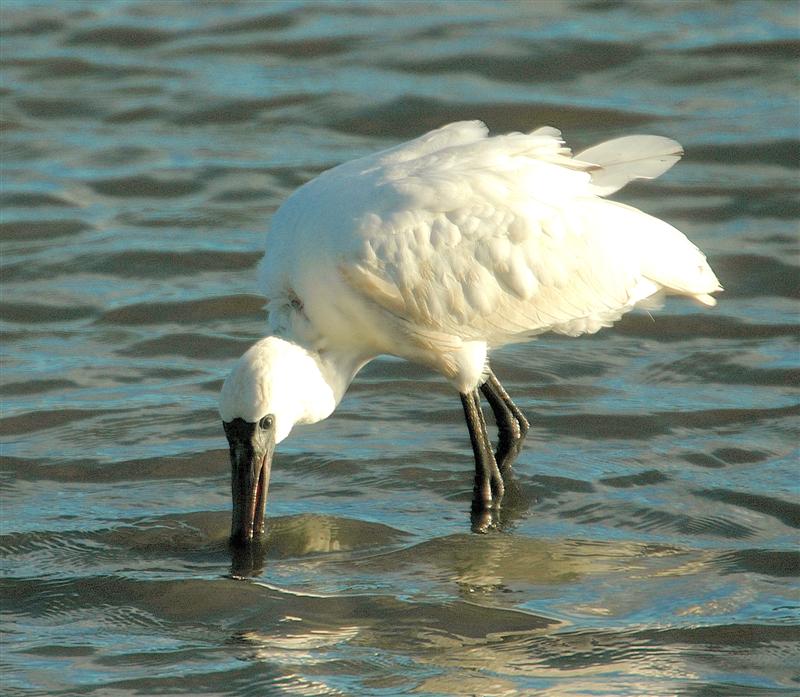 s able to photograph the feeding bird from the bridge and thought; "What a coincidence! Viewing a 'Royal' on the Queen's Birthday holiday.
[Ed. comment: The Royal Spoonbill is a rare species in Tasmania and this bird (I think) has been about the Orielton Lagoon/Sorell area for sometime. I've seen it on a number of occasions, but never able to find it in a photographable position. Thanks Geoff, I hope you'll become a regular contributor.]
Tuesday, July 04, 2006
Forest Raven
 As a few may remember, I have been trying to get better shots of Forest Ravens, and today, in two different venues, I managed to make some improvement. While processing the shots, I realised that far from being black, seen in the right light, they're a rather nice, shiny, dark royal blue. For some time I believed, wrongly, that they were a Tasmanian endemic, perhaps the latin name corvus tasmanicus suggested that. I can recall photographing a very co-operative 'crow' on Wilson's Promontory some years back. It looked
  all too familiar and it was! Other populations are found in The Otways and North Eastern NSW. If it's as successful on the Mainland as here in Tasmania, the population could be expected to expand. Forest Ravens can be found virtually anywhere in the state. Their ID is made easier by being the only 'crow' found throughout Tasmania, with the exception of King Island, which they share there with the commoner Little Raven.
I assume, the bird at top, is making a territorial statement, or perhaps advertising for a mate, as it appeared to be alone. It was photographed at the lookout on top of Rosny Hill, in the late afternoon sun.
Monday, July 03, 2006
Declining Rosella?
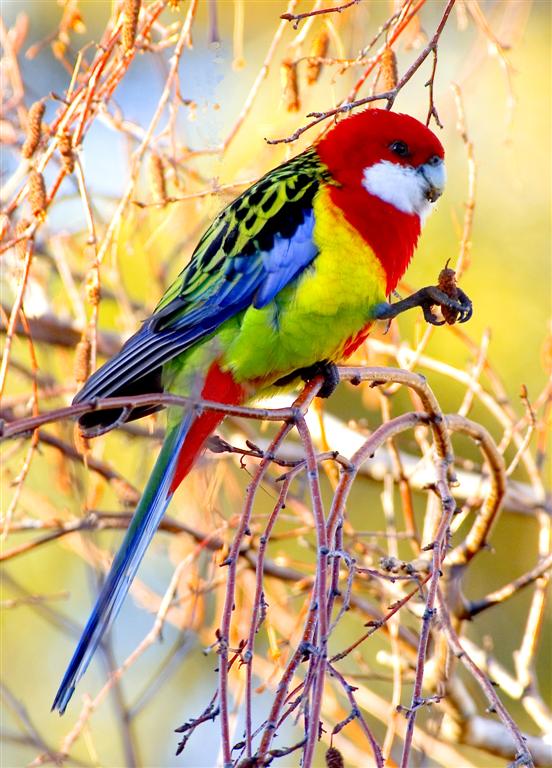 There has been some debate in Tasmania recently, on the subject of whether there has been a decline in Eastern Rosella numbers. In my suburb of Bellerive the numbers seem to have been pretty static for years, although the numbers are only of the order of perhaps 10-15 birds. Certainly they breed in the coastal strip here, although I rarely see any obviously young birds. Michael Sharland, writing in 1945 in his Tasmanian Birds, mentions flocks of upto 20 birds being not uncommon in the Cambridge area. Flocks at the Hobart Airport (near Cambridge) and on the now defunct golf course there, frequently number 60+ during the Winter months, indicating that in places they are more than holding their own. It has been suggested that competition with the introduced Common Starling for breeding sites may have caused a decline in numbers. Perhaps the decline is more noticeable in farming areas.
I can remember my first sighting of an Eastern Rosella on my arrival from England, a lifetime ago now. It was my first sighting of an Australian native species that I could identify--it predated field guides-- but the vivid colouration suggested it belonged to a more exotic place. Although we tend to take Easterns for granted these days, it would be a sad day if they disappeared from the suburbs.
I have found that the local Rosellas are surprisingly difficult to approach and I rarely get close enough to get a reasonable shot. The accompanying image was taken over the weekend a short distance from my home. This bird, one of three, was feeding on Silver Birch catkins, a favourite Winter food.
Sunday, July 02, 2006
Jumping to Conclusions
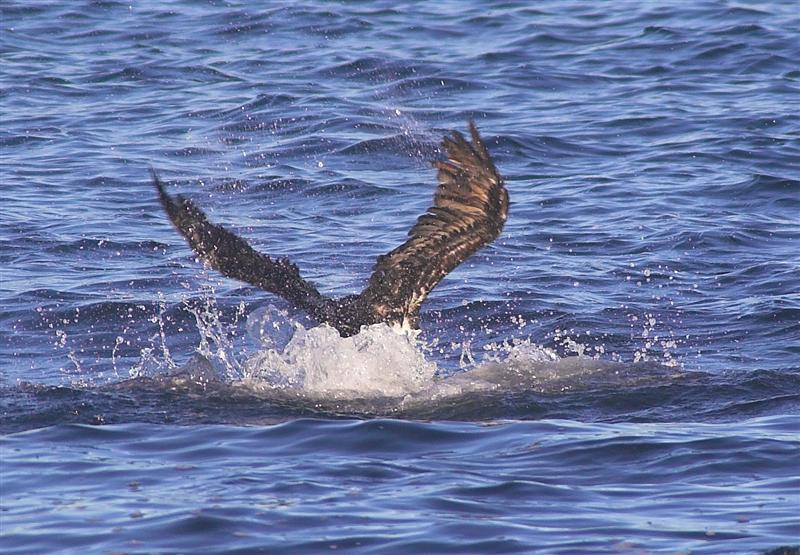 I must say that I am apt to jump to conclusions, frequently the wrong ones, and this morning's episode was no exception! I often watch the Black-faced Cormorants fishing off the nearby rocks in the Derwent River and I'm firmly of the believe that the increased numbers around here are the direct result of the banning of fish netting in the Derwent. I know that Cormorants and Little Penguins were often a bye catch of netting, and the lack of netting should have increased the food available. But, I digress. This morning I watched the antics
 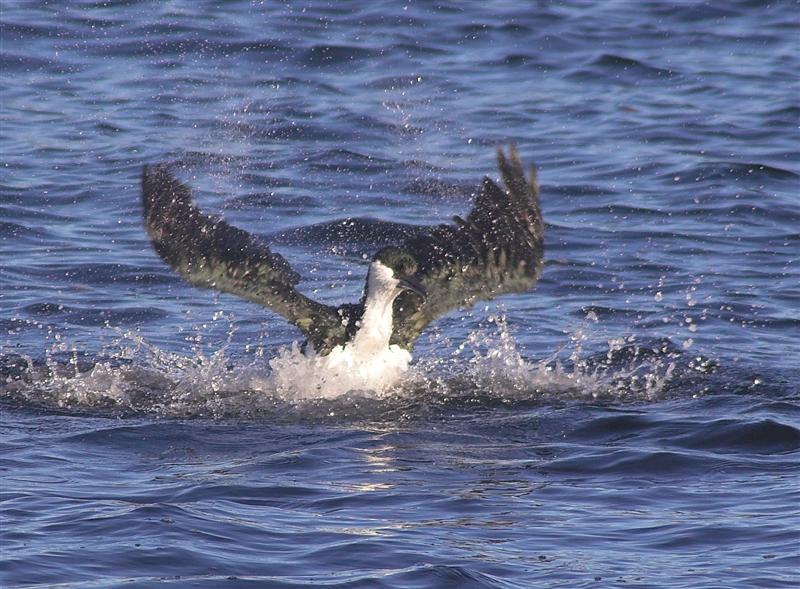 of a Black-faced shown in the images at left. I convinced myself that I was photographing this bird using a fishing technique I had not previously observed. For several minutes it repeatedly splashed on the surface, followed each time by a shallow dive, kicking up a spray of water, zig zagging as it went and all the time getting closer to the rocks. I thought that this was a method of driving fish towards the rocks, and I was fortunate to be recording it. The truth, I'm disappointed to say, was rather more mundane. This bird was actually only having a good wash
  before retiring to the rocks to dry. You may scoff, but in my defence, I can only say that this was the first time I had witnessed this behaviour and I'm a little wiser! I hope at least the pi
 ctures are interesting.
Thursday, June 29, 2006
Changing Habitat
 I've always been intrigued by the ever changing breakdown of species that inhabit my back garden. Over the years a number of large trees, mainly European species have been removed and others, mainly West Australian eucalypts, have supplanted them. The movement of the 70s and 80s encouraging householders to 'go native', have seen many changes to mine and the surrounding gardens. The downside of this has been that, as the trees and shrubs have matured, a few species have dominated. Gone, except as very occasional visitors, are the smaller honeyeaters that frequented this area, particularly in the Winter, replaced by the 'bullies', the Little Wattlebirds and the Noisy Miners. A few others manage a living, Musk Lorikeets, Eastern Rosellas, the odd Crescent Honeyeater, and even an occasional (and welcome) Yellow-tailed Black Cockatoo. Of course, we have almost the full range of exotics too! The Noisy Miners started using the garden in numbers, in the mid 80s, and now are regular visitors, harried, but unbowed, by the resident breeding pairs of Little Wattlebird. The Tasmanian sub species of the Noisy Miner, is substantially larger than the its Mainland cousins (Bergman's Rule kicking in). Perhaps that goes some way to explaining why the Noisy Miner I photographed this morning (top right) in a beachside car park, was drawn to a discarded meat pie, although I couldn't determine whether it was eating the meat or the pastry!
Tuesday, June 27, 2006
Yellow-rumps
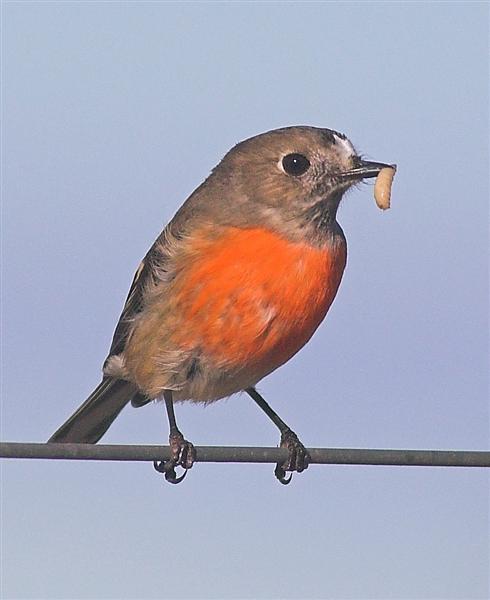 I was returning from Little Swanport on Monday (see posting below), and pulled in to the side of the road, just South of the Triabunna bridge, to count a small flock of Pelican. As I did, I noticed a robin on the fence wire, hunting insects. Using the car as a hide, I positioned myself to get a shot or two. The female Scarlet Robin (at left) was very obliging, returning to the same spot on the wire between sorties. As I concentrated on photographing this robin, I heard the familiar "tinkling" of Yellow-rumped Thornbills, but took little notice. The continued "tinkling" eventually got my attention--the flock of about 6 or 7 birds, had landed on the wire alongside me and much closer than the robin. A hurried change of angle, enabling me to take a few shots (one shown at lower left), before the flock
  moved on. While the shot suffers somewhat from having a dark background, I was pleased to have come to grips with a common enough bird, but one that had eluded me (as far as photos go) . Are there less of them around this Winter? As I continued on my way feeling quite pleased with my good fortune, I realised that I never did count the pelican!
Monday, June 26, 2006
Saltworks Excursion
 On a beautiful Winters morning after a hard frost, I decided on a foray to the Saltworks Reserve, North of Triabunna. Scenically, probably one of the best, the picture at right was taken from the mouth of Little Swanport, looking inland. The spit in the middle ground, had a roost of some 32 Australian Pelicans this morning, 2 of which were banded(rt leg). Other birds occupying that beach included, c.10 Red-necked Stint, 2 Hooded Plover, several Pacific Gulls, c.15 Red-capped Plover
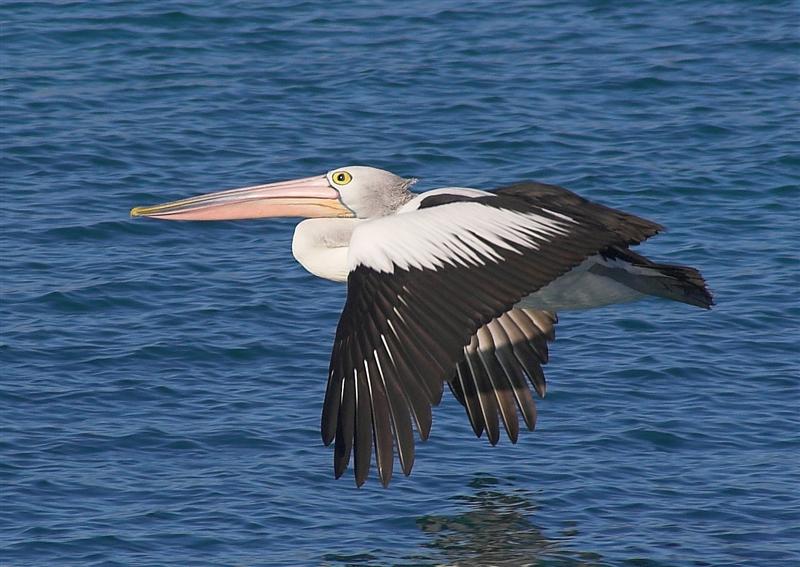 and 2 pairs of Pied Oystercatcher. The most numerous species was Crested Tern, probably numbering 150+, but as they constantly passed from the oyster racks out to sea and back, that's a guess. Several of the Pelicans took off and headed North (including the one pictured). Other birds present in the area, included Little Pied Cormorant, Black-faced Cormorant, Australasian Gannet, Grey Butcherbird, White-faced Heron, Grey Currawong, and a solitary White-breasted Sea Eagle. En route, I stopped briefly at Rostrevor Lagoon (about 1 km N.of Triabunna), and noted at least 12 Blue-billed Duck and 20+ Blue-winged Shoveller. Rostrevor is, arguably, the most consistent spot in Tasmania to see Blue-bills.
Friday, June 23, 2006
Small Influx and A Puzzle
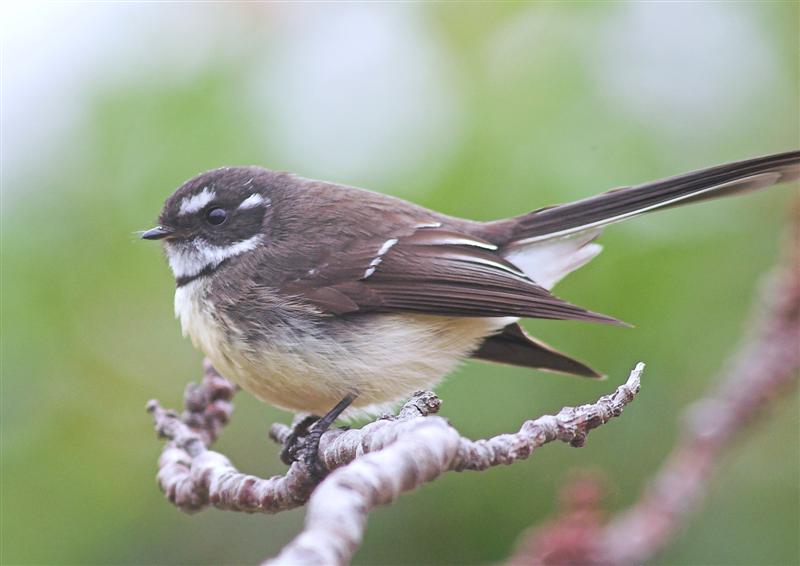 I suppose that one advantage of walking the same area frequently, is that you may notice small nuances of bird behaviour or numbers. My almost daily walk, takes me past adjoining gardens, past tree lined ovals and includes a small headland reserve, which includes a rocky shore. Yesterday, which was a little warmer than of late, I saw quite an increase in birds that infrequently are seen on this walk. They included several Eastern Spinebills, Grey Fantails, Yellow-throated Honeyeaters and a few Scarlet Robins. I alluded to it being a little warmer than of late, earlier, and I can only suppose that this may have caused the very welcome increase.
Well I'd almost wrapped this posting up and I was just checking on the images, when I realised that the image of the robin could be a female Pink Robin. It could account for it's behaviour, which was far more skulking than I would expect of a Scarlet (and quite alone). Unfortunately, it was photographed in deep shade, which confuses the colouring. Pink Robin do roam during the Winter, but would be a first record for this area. Any suggestions w
 ould be welcome. I'll add another angle image.
Wednesday, June 21, 2006
Wedgetail Encounter
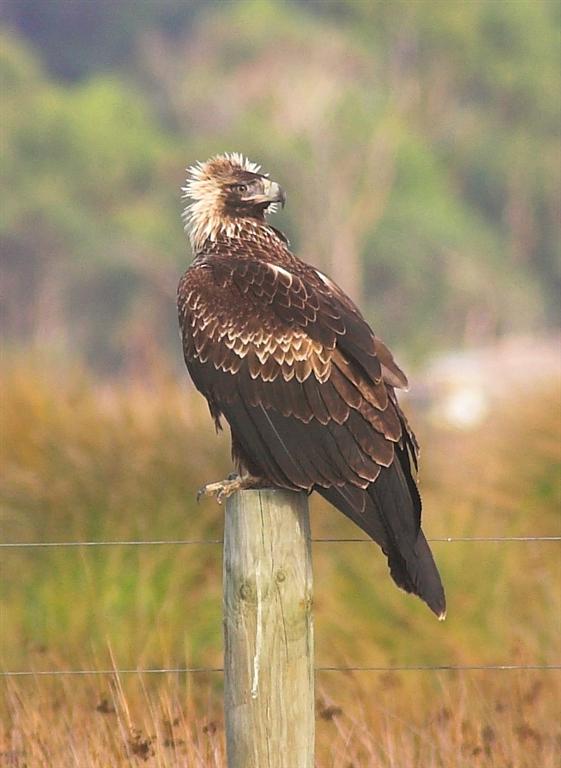 I have a confession to make! Although I wrote about visiting duck haunts in the previous blog, the real highlight of the morning was an encounter with a Wedge-tailed Eagle. I feel so much better now!
I had driven along the Marion Bay Rd. towards Dunalley, and among the birds I noted were 2 Wedgetails sitting together on the branch of a dead tree some way up the bank and overlooking Blackman Bay. They were still there when I came back and although I tried photographing them they were too far away. I then crossed the causeway towards the beach, photographing a Little Egret on the way, and then on to the Long Spit Rd.. Whenever I go down this 'road' (it's deteriorating fast) I always keep an eye on the fences. Often there will be a bird of prey, chats, swallows etc. using the fence as a perch to view over the open paddocks/marsh. I noticed an obvious bird of prey in the distance on the fence, but a paddock away, but as I drew closer, I realised it was "big". I stopped and took the shot at top left, surprised that it allowed me to get so close. Three Wedgetails in 10
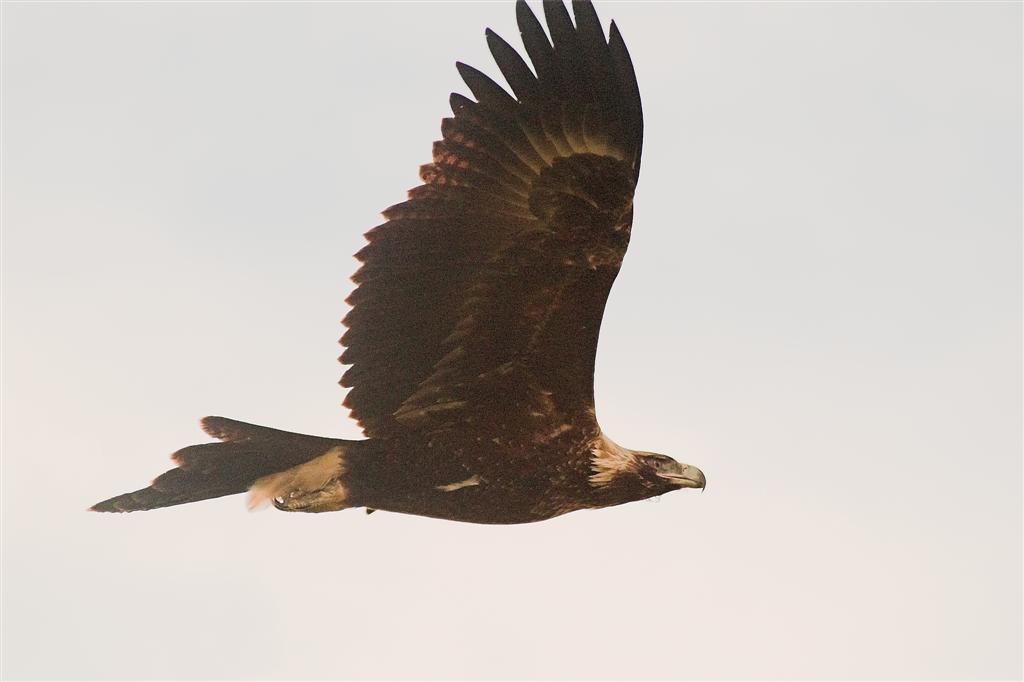 minutes! It finally took off towards the spit and I managed a few more shots before I lost sight of it. I moved on to the end of the road, and was preparing to walk to the beach, when it flew out of the tree I'd parked under!! If that wasn't enough it came back for a second run, unfortunately from a photographic standpoint, with the sun right behind it. The shot at left is of poor quality, but is the full frame 'as shot', which may give a
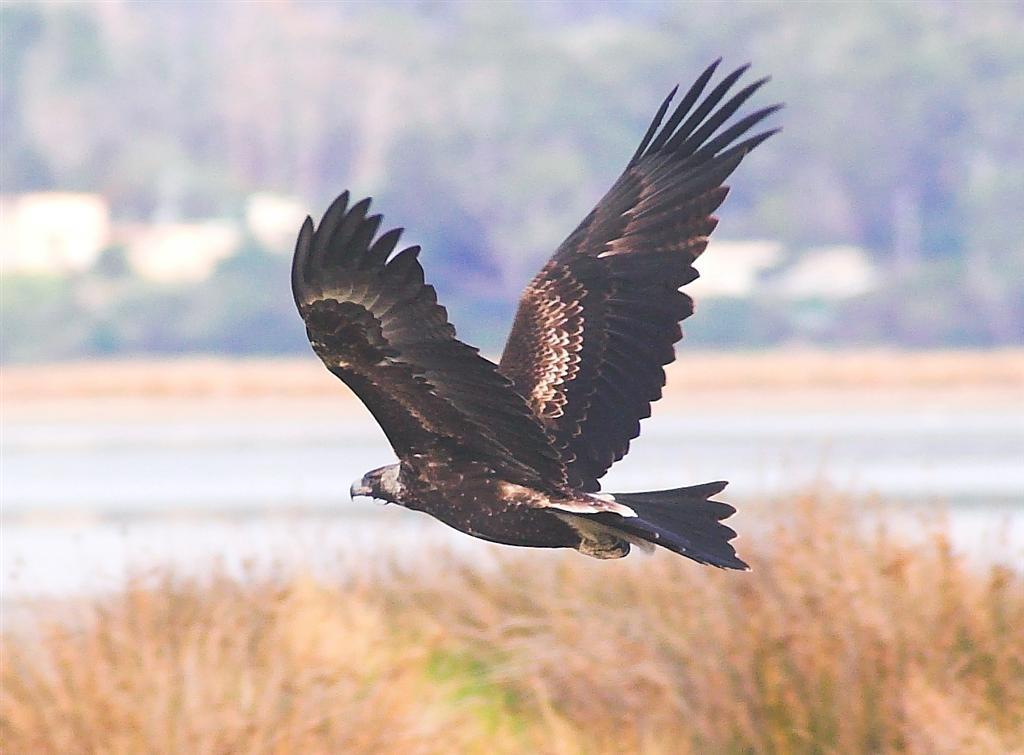 n idea of how close it came. In the idiom of the day, "awesome".
Tuesday, June 20, 2006
Ducks Abound
Drove round several of the local (Eastern Shore) duck haunts this morning and noted an increase in the numbers  over last month. Of most interest was the flock of 32 Hardheads (part of the flock top left) at the Orielton Settling Ponds, a spot that more often has a modest flock of Wood Duck. Moved on to Lewisham, where the, fast drying out, 'duck pond' alo
 ngside the road, had the usual Chestnut Teal, 3 Black-fronted Plover, and 6 pairs of Bluewinged Shoveller (1 male pictured at right). On to Blackman Bay area, where there were over 300 Chestnut Teal feeding on the exposed areas of the bay. On a small farm dam near Copping sports ground, that I could almost jump over, there were c.60 Black Duck. It's noticeable that many of the duck have paire
 d and chase of suitors if they get too close to mates. Noted a pair of nesting Masked Plover (with eggs) at Marion Bay.The Chestnut Teal
 pictured (female left, male right) were photogaphed at Lewisham. [Lewisham 'pond' is a relatively easy spot to photograph various waterfowl, particularly if you use the car as a hide]
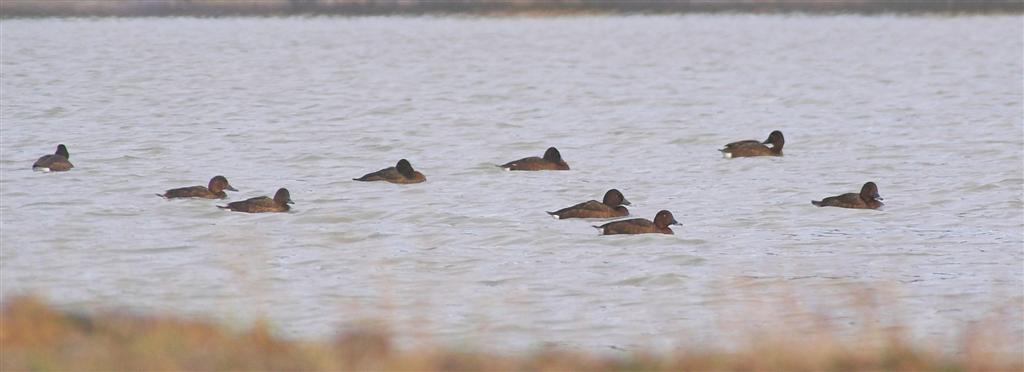 over last month. Of most interest was the flock of 32 Hardheads (part of the flock top left) at the Orielton Settling Ponds, a spot that more often has a modest flock of Wood Duck. Moved on to Lewisham, where the, fast drying out, 'duck pond' alo
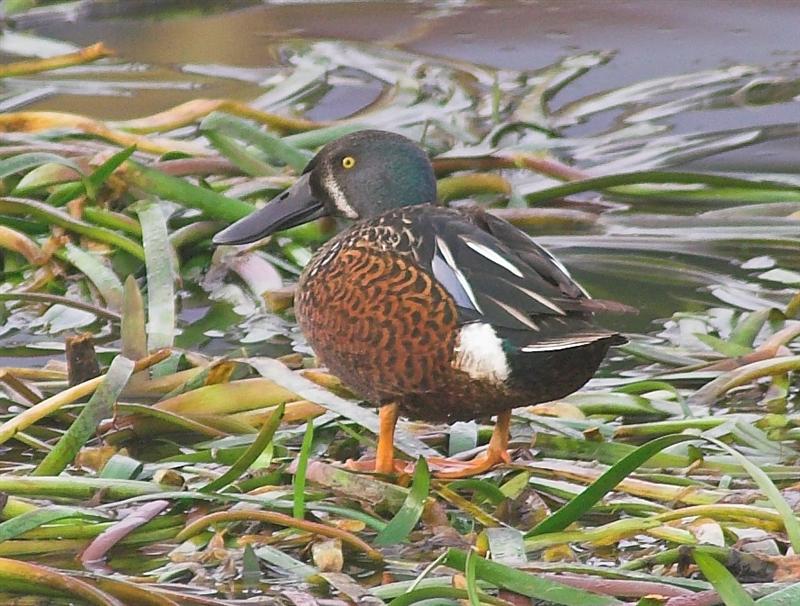 ngside the road, had the usual Chestnut Teal, 3 Black-fronted Plover, and 6 pairs of Bluewinged Shoveller (1 male pictured at right). On to Blackman Bay area, where there were over 300 Chestnut Teal feeding on the exposed areas of the bay. On a small farm dam near Copping sports ground, that I could almost jump over, there were c.60 Black Duck. It's noticeable that many of the duck have paire
 d and chase of suitors if they get too close to mates. Noted a pair of nesting Masked Plover (with eggs) at Marion Bay.The Chestnut Teal
 pictured (female left, male right) were photogaphed at Lewisham. [Lewisham 'pond' is a relatively easy spot to photograph various waterfowl, particularly if you use the car as a hide]
Subscribe to:
Posts (Atom)