Tuesday, February 28, 2006

Musselcatchers

The name doesn't quite have the same 'ring' about it as Oystercatchers, but at this time of year, both of our species of Oicks, may be seen feeding on mussels. I'm not sure whether any of this World wide group of birds, actually eats oysters as a prime food source. I believe in England, where they were probably first named, their main food is cockles, which begs the question, why they were dubbed 'oystercatchers'!
At this time of year, there is a bigger than usual tidal range, at least locally, and at the low point of the tide, expanses of the shore and rocks not normally seen, are exposed. Among the 'winners'
are the oystercatchers.
These accompanying images were shot on my almost daily 'constitutional', that encompasses the Second Bluff at Bellerive, a spot I look forward to, just to enjoy the various shorebirds that mainly use this area as a roost.

Monday, February 27, 2006

Quail?

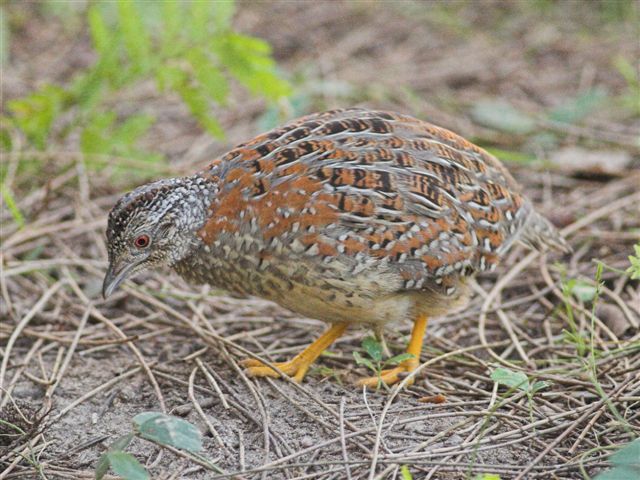
Murray Lord sent me the accompanying shot of a Painted Button-quail and commented that this was the first one he had seen since 1985. By the way this one was photographed at the Warriewood Wetlands in NSW. My reason for including it here is to pose the question of Quail sightings. There was a time when I regularly flushed quail at such places as Seven Mile Beach reserve, Goat Bluff South Arm, Mortimer Bay and many places in the Huon area, but I can't actually recall the last one of any species that I've seen.
My last sight of a Painted Button-quail in Tasmania, was during the first Atlas, in the late 1970s from memory, when Mike Newman showed me a pair at Lenah Valley. They were very approachable, just as Murray mentions his was.
Am I alone in not seeing quail these days? I would be interested in receiving comments.
[Murray shot this at 3200ISO, but they still seem pretty good. Murray also mentions that this is the 5th species of Quail/Button-quail, he has seen this month!]

Saturday, February 25, 2006

Sightings

Felix Wilson sent in the accompanying image of a Great Egret taken at Gould's Lagoon on Thursday (23/2). He asks whether this is an early record of a bird arriving from the Mainland. Certainly egrets in any numbers usually start arriving in the Autumn, but I have noticed one occasionally during the Summer at this venue, so suspect it's that individual. A few, mainly Great Egrets and the odd Little, do overstay during the Summer months.
A report of 29 Great-crested Grebes from Moulting Lagoon last week is an interesting record. A few can often be seen in or near Orielton Lagoon.

Friday, February 24, 2006

Who's been visiting my domain?

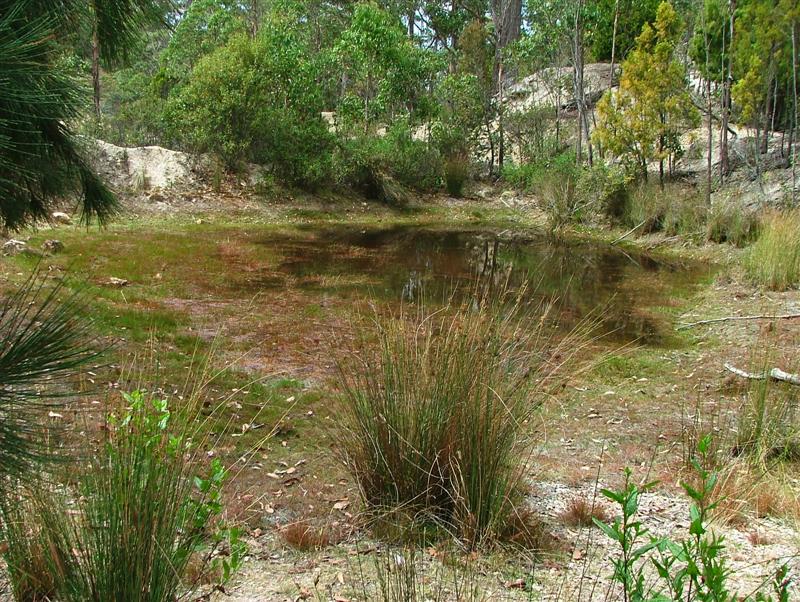
John & Shirley Tongue write: On Thursday we went exploring, to find THE waterhole in the Red Gate section of the Meehan Range Recreation Area. There were LOTS of species around (positively identified 21 species by sight or call in a couple of hours), but it was the middle of the day, so many things were staying away from the waterhole. Hence, I include a shot of the pool itself, but don't have any shots of birds there. A bit of a bonus was the feed of blackberries we had near the entrance to the walking track! One thing that did strike us was the number of Yellow-rumped Thornbills around. We saw lots last week, too, out to the East of Sorell. Maybe it's just the time of year, or maybe the areas we've been in, but we haven't really noticed so many before. Of course, they're not going to sit still to be photographed! Anyway the waterhole would cetainly be worth a re-visit closer to dawn or dusk.

[I can confirm, John, that this is IT. I was there earlier on Thursday, but I think the cooler weather affected bird numbers. I think you will find that at this time of year, almost any water will attract birds. I know that wheel ruts with water in, will often attract birds from 'miles' around in dry or sandy areas.]

Wednesday, February 22, 2006

Smile Please!

One of the purposes of running this blog is to encourage readers to give digital photography a go. It has many advantages over 'conventional' film photography--it probably won't be long before we refer to digital as conventional!--and after the initial expense, is considerably cheaper on running expenses. I'm pleased that a number, albeit few, people have contributed and a few others are in a throes of buying the gear.
On a typical morning of photography, it's not unusual to shoot up to 100 images, the vast majority will probably be deleted, for a range of reasons. But that's the joy of 'digital', the costs are the same basically whether you shoot 100 or 1. Yes, there is a learning curve, but not beyond the skill of most people, and a pretty cheap one too. Because you have a digital image it can easily be edited, framed and generally tidied up. Will your images
reach the standard seen on some of the bird photography websites? Probably not, but I can say from personal experience, that it will improve your enjoyment of birding beyond measure. Having birded in Tasmania for 40+ years, I can reasonably say that I have "been there, done that". I have travelled most of the state, including the islands, banded, counted, atlassed and heaven knows what else! I needed a new outlook, and digital photography has worked wonders. Why not consider giving it a try.
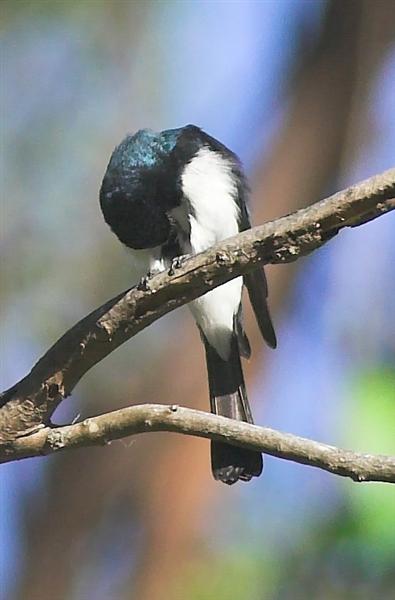
As you can see from the accompanying images, not all birds will co-operate! A female Superb Blue Wren and a male Satin Flycatcher giving me a hard time.

Tuesday, February 21, 2006

Queen's Domain Cockatoo


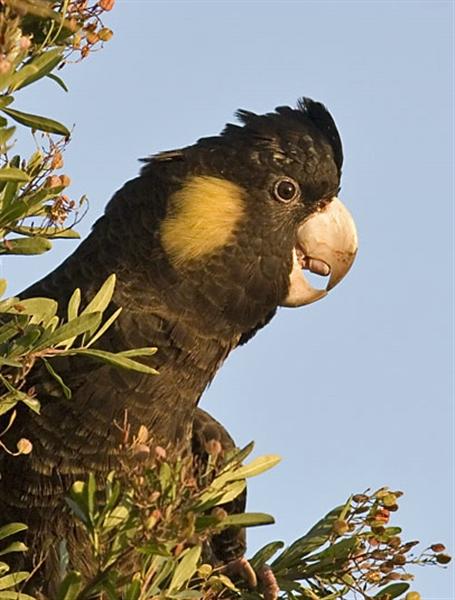
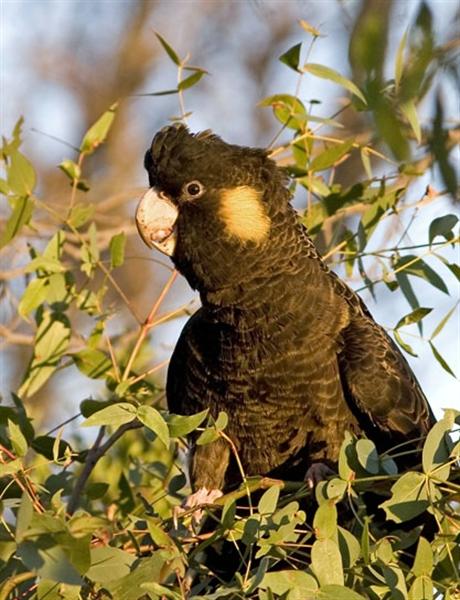
Felix Wilson sent these nice shots of a Yellow-tailed Black Cockatoo, photographed in the early morning sun's rays on the Queen's Domain in Hobart, last Thursday. He comments that this was a
lone bird and that he usually expects to see them in flocks and maybe this was an outcast of some sort. He also mentioned that the Domain is a good spot for Eastern Rosellas, pardalotes and the ever present Noisy Miners.

[The bird pictured is most probably an immature female, but I'll stand to be corrected by someone who has more experience with this species. Certainly, I haven't been aware of the large flocks that were around 15 or more years ago, but they seem to turn up more frequently these days in coastal heath and in the suburbs, including my garden, where they made short work of the cones of one of my Banksia Integrifolia! ed]


Monday, February 20, 2006

Susie Islet

John & Shirley Tongue write: We were out for a days drive and birding on Thursday (16th Feb). As we headed out towards Sorell, we stopped for the obligatory look along the edges of Orielton Lagoon, and were amazed at the number of birds on Susie Islet ( the tiny islet out in the lagoon on the North side of the Midway Point-Sorell Causeway). On closer inspection, not only were we surprised at the number of birds, but by the variety of species, on such a tiny speck of land. There were Silver and Kelp Gulls, Great, Black-faced, Little Black and Little Pied Cormorants, Pelicans, Crested Terns, Chestnut Teal, and Pied Oystercatchers. There were also Great-crested Grebes and Musk Duck working the waters close by. We didn't spot the oft-noted Royal Spoonbill, however. We were left wondering whether there are many spots around Tassie with a higher species density. The accompanying pic. doesn't show any particular bird to best advantage, but does give some idea of the cluster.

[ Worth keeping an eye out for the occasional Pied Cormorant here too--a rarity in Tasmania ed.]

Friday, February 17, 2006

Bluewings Revisited


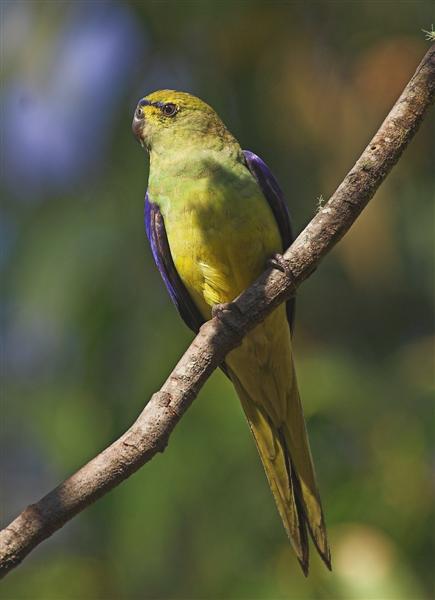
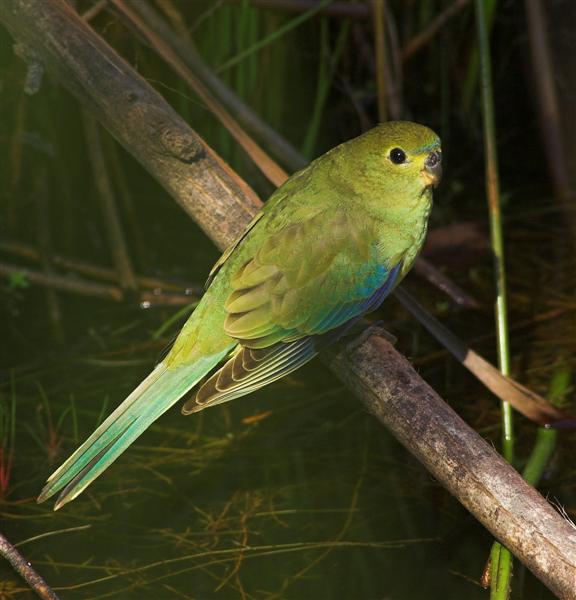
Patience is a virtue so the saying goes and in recent years I can't say it's been one of mine. But this morning I hung in there. As I photographed at the waterhole, I became aware of a Blue-winged Parrot arriving at the top of a 30metre dead tree, high on the bank overlooking the area. I hoped it would come down and drink. After what seemed an eternity, and via a number of other trees it finally made it to the edge of the water about 20 metres away. However in the excitement of the moment, I had failed to notice that just below me (I was standing on the wall of the dam) hidden from view by scrub, was a Green Rosella. It flushed as I repositioned myself, with it's "cusick", "cusick" call reveberating around the hills, it in turn flushed the Bluewing. I wasn't that pleased!!

An hour or so later, after hearing small flocks pass overhead with their "tinkling" call, I noticed one had appeared on the branch only 3 or 4 metres away. I very slowly turned the camera round and took several shots. Shortly after, several others appeared, and warily approached the water. Some to bathe, almost at my feet, although I couldn't see them and others walked to the water and drank. Surprisingly to me, they all bathed and drank singly and not in a flock. In ten minutes it was all over. That was enough excitement for one day for me too!

Thursday, February 16, 2006

Bronzewing Strategy

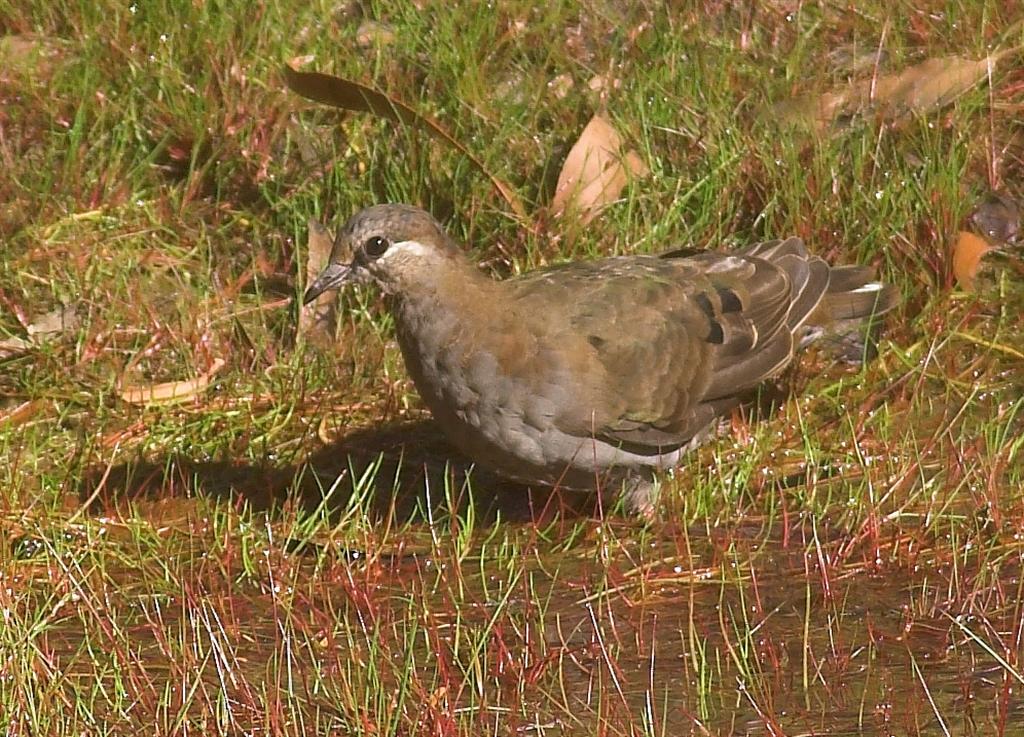
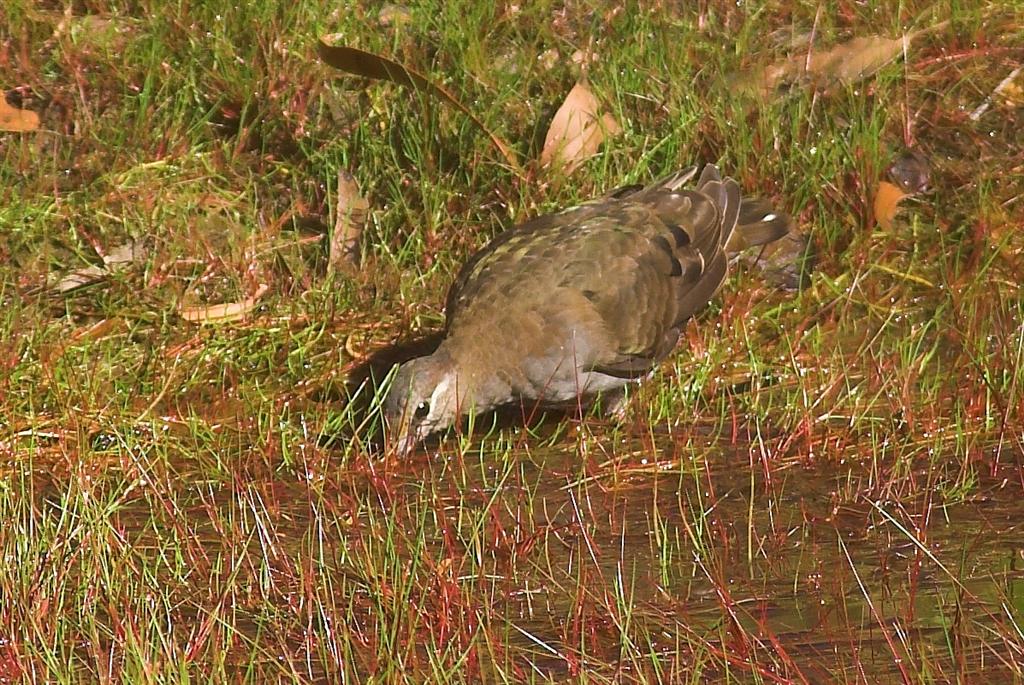
Spent an hour or so at 'The' waterhole in the Meehan Range recently. It was interesting to watch the differing strategies used by the various species wishing to bath, drink, or both, at this venue. Some, like the Satin Flycatchers are relatively bold and seem more interested in seeing off other flycatchers, than worrying about predators. Others, like the Green Rosellas, do reconnaissance flights over the area, before spending a while just watching and then going for it. Silvereyes and Brown Thornbills, seek safety in numbers and use cover to reach their chosen spot. The Common Bronzewing uses yet another strategy. Landing some 6 or 7 metres away in a
clear area, then walking, very warily along the edge of the water, stopping frequently, using an agitated head nodding (not bobbing), before making a nervous approach to the water and drinking. A reverse strategy was used as it left the water, before a noisy wing clapping as it flew off. (These images were taken from about 20 metres away).
The area supports a good population of Common and a few Brush Bronzewings. I could hear several "ooming" as I took these shots.

Tuesday, February 14, 2006

More Plovers

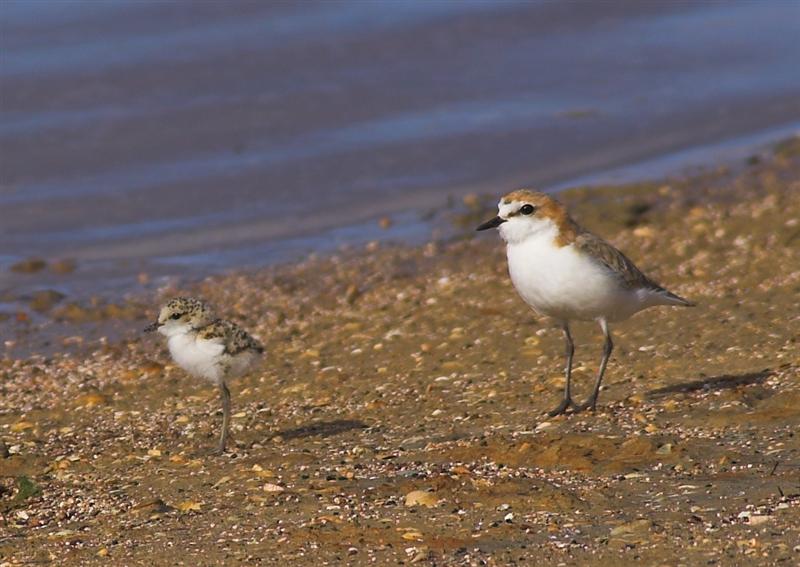
Took the accompanying images this morning in great light and you'll have to indulge me again as I blog them. Surprising number of Red-capped Plovers at Pipeclay Lagoon where these were taken. As you can see from the female with a runner, there are still some breeding. From my experience they have a long breeding season, starting in August and ranging sometimes into late March.

Double-banded Plover

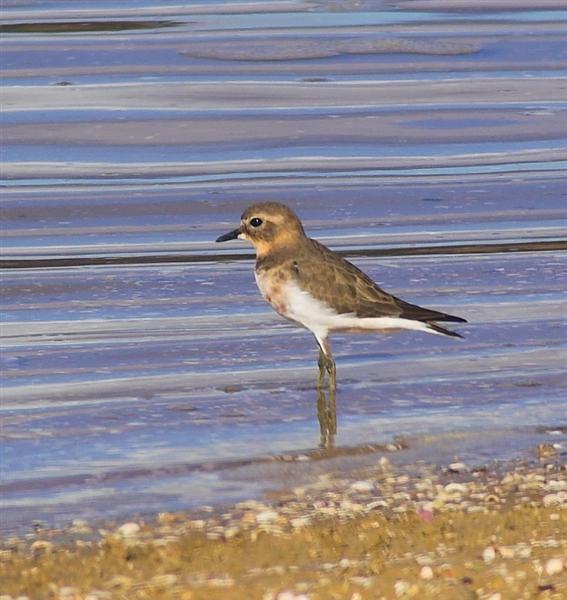
It's that time of year when the Double-banded Plover put in an appearance. A trans Tasman migrant, it can be found around the state, on the coast and inland. Usually in discrete flocks, this photo shows one of two seen at Pipeclay Lagoon this morning, not sure whether to flock with the Red-caps or the stint.